Banner
Pilot Study: Fibromyalgia Fatigue Improved By TENS Therapy

Fibromyalgia is the term for a poorly-understood condition where people experience pain and fatigue...

High Meat Consumption Linked To Lower Dementia Risk

Older people who eat large amounts of meat have a lower risk of dementia and cognitive decline...

Long Before The Inca Colonized Peru, Natives Had A Thriving Trade Network

A new DNA analysis reveals that long before the Incan Empire took over Peru, animals were...

Mesolithic People Had Meals With More Tradition Than You Thought

The common imagery of prehistoric people is either rooting through dirt for grubs and picking berries...

User picture.
News StaffRSS Feed of this column.

News Releases From All Over The World, Right To You... Read More »

Blogroll
Just when you thought evolution couldn't get attacked by anyone else, a zoologist writing in Science and his colleagues are contending that changing winter conditions due to global warming are causing Scotland's wild Soay sheep to get smaller despite the evolutionary benefits of having a large body.  Yep, climate change can trump natural selection, it turns out. 

So much for adapting to the environment.   Too bad Darwin didn't know about CO2.  
On television, police technicians zoom in on a security camera video to read a license plate or capture the face of a hold-up artist but, in real life, enhancing this low-quality video to focus in on important clues hasn't been an easy task.

It just got a little easier.   Prof. Leonid Yaroslavsky of Tel Aviv University and colleagues have developed a new video "perfection tool" to help investigators enhance raw video images. Commissioned by a defense-related company to improve what the naked eye cannot see, the tool can be used with live video or with recordings, in color or black-and-white. 
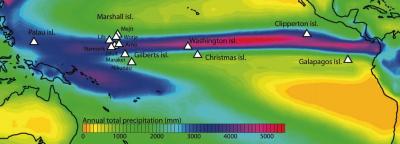
The rain band near the equator that determines the supply of freshwater to nearly a billion people throughout the tropics and subtropics has been creeping north for more than 300 years,  according to research published in Nature Geoscience

If the band continues to migrate at just less than a mile (1.4 kilometers) a year, which is the average for all the years it has been moving north, then some Pacific islands near the equator – even those that currently enjoy abundant rainfall – may be drier within decades and starved of freshwater by midcentury or sooner.

Global warming?  Maybe.  But if it is, the arid event could happen even sooner than current projections.  
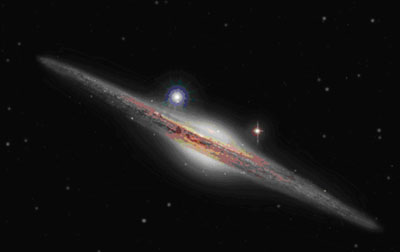
Astronomers using ESA’s XMM-Newton X-ray observatory have discovered a black hole they labeled HLX-1 (Hyper-Luminous X-ray source 1), which lies towards the outskirts of the galaxy ESO 243-49, approximately 290 million light-years from Earth and weighs more than 500 solar masses, making it a 'missing link' between lighter stellar-mass and heavier supermassive black holes. This discovery is the best detection to date of a new class that has long been searched for: intermediate mass black holes.
 
The discovery has been made by an international team of researchers working with XMM-Newton data, led by Sean Farrell from the Centre d’Etude Spatiale des Rayonnements, now based at the University of Leicester. 
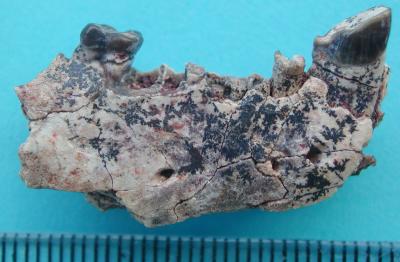
Look out, Ida.   Hot on the heels of one overhyped mishmash of media hysteria, a new fossil primate from Myanmar/Burma called Ganlea megacanina is causing researchers to speculate that the common ancestor of humans, monkeys and apes evolved from primates in Asia, not Africa, as many researchers believe. 

A major focus of recent paleoanthropological research has been to establish the origin of anthropoid primates (monkeys, apes and humans) from earlier and more primitive primates known as prosimians (lemurs, tarsiers and their extinct relatives).
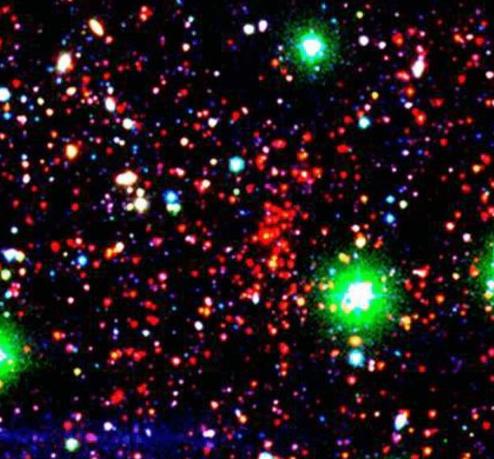
Researchers have completed the largest ever survey for very distant clusters of galaxies. 

Named the Spitzer Adaptation of the Red-sequence Cluster Survey, "SpARCS" detects galaxy clusters using deep ground-based optical observations from the CTIO 4m and CFHT 3.6m telescopes, combined with Spitzer Space Telescope infrared observations. 

SpARCS is designed to find clusters as they appeared lwhen the universe was 6 billion years old or younger.  Astronomers believe the universe was formed 13.7 billion years ago.