Banner
Pilot Study: Fibromyalgia Fatigue Improved By TENS Therapy

Fibromyalgia is the term for a poorly-understood condition where people experience pain and fatigue...

High Meat Consumption Linked To Lower Dementia Risk

Older people who eat large amounts of meat have a lower risk of dementia and cognitive decline...

Long Before The Inca Colonized Peru, Natives Had A Thriving Trade Network

A new DNA analysis reveals that long before the Incan Empire took over Peru, animals were...

Mesolithic People Had Meals With More Tradition Than You Thought

The common imagery of prehistoric people is either rooting through dirt for grubs and picking berries...

User picture.
News StaffRSS Feed of this column.

News Releases From All Over The World, Right To You... Read More »

Blogroll
The dual launch of the far-infrared space telescope Herschel and cosmic background mapper Planck on an Ariane 5 rocket from Europe's Spaceport in French Guiana is the beginning of two of the most ambitious missions ever attempted to unveil the secrets of the darkest, coldest and oldest parts of the Universe.
 
Herschel has the largest mirror ever launched into space and will examine a little known part of the electromagnetic spectrum to learn more about the birth of stars and galaxies as well as dust clouds and planet-forming discs around stars - and will look for water, a key component of life similar to ours. 
Monkeys playing a game similar to "Let's Make A Deal" have revealed that their brains register missed opportunities and learn from their mistakes. 

The researchers watched individual neurons in a region of the brain called the anterior cingulate cortex (ACC) that monitors the consequences of actions and mediates resulting changes in behavior. The monkeys were making choices that resulted in different amounts of juice as a reward. 

Their task was like the TV show "Let's Make a Deal" with the experimenters offering monkeys choices from an array of hidden rewards. During each trial, the monkeys chose from one of eight identical white squares arranged in a circle. A color beneath the white square was revealed and the monkey received the corresponding reward. 
To study small RNA, snippets of RNA that act as switches to regulate gene expression in single-celled creatures, you need lab-cultured microorganisms but a new method of obtaining marine microbe samples while preserving the microbes' natural gene expression has shown the presence of many varieties of small RNAs.  

The discovery of its presence in a natural setting may make it possible finally to learn on a broad scale how microbial communities living at different ocean depths and regions respond to environmental stimuli.
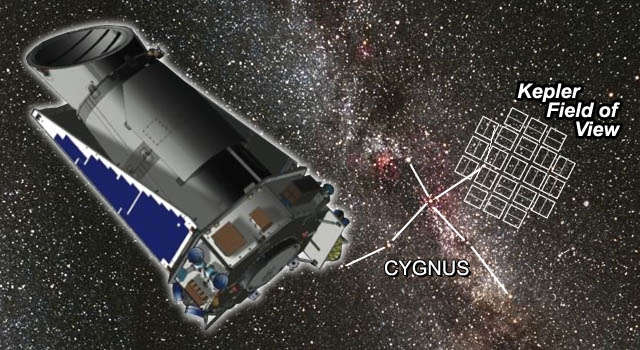
NASA's Kepler spacecraft has begun its search for other Earth-like worlds. The mission, which launched from Cape Canaveral, Fla., on March 6, will spend the next three-and-a-half years staring at more than 100,000 stars for telltale signs of planets. Kepler has the unique ability to find planets as small as Earth that orbit sun-like stars at distances where temperatures are right for possible lakes and oceans. 
A bowl of whole-grain cereal is as good as a sports drink for recovery after exercise. Research published in BioMed Central’s open access Journal of the International Society of Sports Nutrition has shown that the readily available and relatively inexpensive breakfast food is as effective as popular, carbohydrate-based ‘sports drinks’.
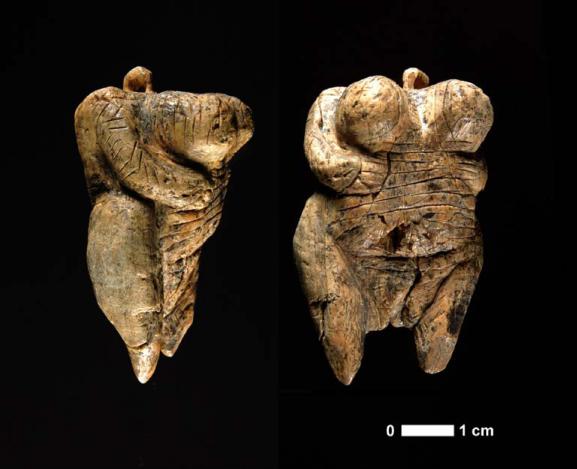
2008 excavations at Hohle Fels Cave in the Swabian Jura of southwestern Germany recovered a female figurine carved from mammoth ivory from the basal Aurignacian deposit. The figurine is the earliest depiction of a human and one of the oldest known examples of figurative art worldwide and is at least 35,000 years old.

If you're looking closely at the Venus of Hohle Fels below, you may also notice those are breasts, which radically changes our views of the context and meaning of the earliest Paleolithic art; maybe it's porn-eolithic.

Venus of Hohle Fels Swabian Jura