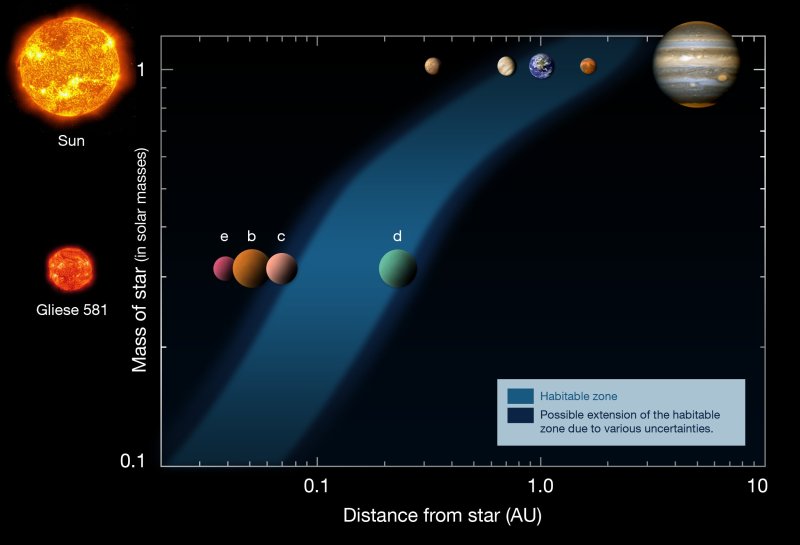
Exoplanet researcher Michel Mayor today announced the discovery of the lightest exoplanet found so far. The planet, Gliese 581 e, in the famous system Gliese 581, is only about twice the mass of our Earth. The team also refined the orbit of the planet Gliese 581 d, first discovered in 2007, placing it well within the habitable zone, where liquid water oceans could exist.
These amazing discoveries are the outcome of more than four years of observations using the most successful low-mass-exoplanet hunter in the world, the HARPS spectrograph attached to the 3.6-meter ESO telescope at La Silla, Chile.
Want to hunt down enemy bacteria? Look at the sugars on the germs' surface where they start building a 'structure' that helps the microbes resist efforts to kill them.
Scientists have determined that the bacterial cell-surface sugar, a polysaccharide called Psl, is anchored on the surface of the bacterium as a helix, providing a structure that encourages cell-to-cell interaction. When multiple bacterial cells join together with the help of such a structure, they form what is called a biofilm, a persistent community of bugs that is able to resist the effects of a human immune response, as well as antibiotic drugs.
Dartmouth researchers have determined that the presence of the rare element osmium is on the rise globally. They trace this increase to the consumption of refined platinum, the primary ingredient in catalytic converters, the equipment commonly installed in cars to reduce smog. A volatile form of osmium is generated during platinum refinement and also during the normal operation of cars, and it gets dispersed globally through the atmosphere.
Thinking your memory will get worse as you get older may actually be a self-fulfilling prophecy. Researchers at North Carolina State University have found that senior citizens who think older people should perform poorly on tests of memory actually score much worse than seniors who do not buy in to negative stereotypes about aging and memory loss.
When we emerge from a supermarket laden down with bags and faced with a sea of vehicles, how do we remember where we've parked our car and translate the memory into the correct action to get back there? A paper in PLoS Biology identifies the specific parts of the brain responsible for solving this everyday problem, which could have implications for understanding the functional significance of a prominent brain abnormality observed in neuropsychiatric diseases such as schizophrenia.
Scientists at Cambridge University have discovered that freshwater algae can form stable groupings in which they dance around each other, miraculously held together only by the fluid flows they create. Their research was published today in Physical Review Letters.
The researchers studied the multicellular organism Volvox carteri, which consists of approximately 1,000 cells arranged on the surface of a spherical matrix about half a millimetre in diameter. Each of the surface cells has two hair-like appendages known as flagella, whose beating propels the colony through the fluid and simultaneously makes them spin about an axis.


 Pilot Study: Fibromyalgia Fatigue Improved By TENS Therapy
 High Meat Consumption Linked To Lower Dementia Risk
 Long Before The Inca Colonized Peru, Natives Had A Thriving Trade Network
 Mesolithic People Had Meals With More Tradition Than You Thought