New research from Vanderbilt University has found students benefit more from being taught the concepts behind math problems rather than the exact procedures to solve the problems. The findings offer teachers new insights on how best to shape math instruction to have the greatest impact on student learning.
The research by Bethany Rittle-Johnson, assistant professor of psychology and human development at Vanderbilt University's Peabody College and Percival Mathews, a Peabody doctoral candidate, is in press at the Journal of Experimental Child Psychology.
Researchers have reported that they have been able to determine the molecular structure of a plant photolyase protein that is surprisingly similar to two cryptochrome proteins that control the "master clock" in humans and other mammals. They have also been able to test how structural changes affect the function of these proteins.
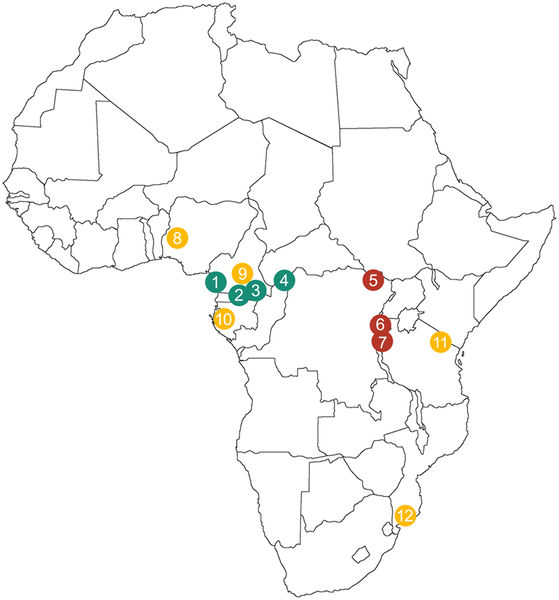
The central African belt is a fascinating look back in time for humanity because the largest group of hunter–gatherers of Africa, the Pygmies, still inhabit the region and they coexist with neighboring farmers.
All African Pygmies, inhabiting a large territory extending west-to-east along Central Africa, descend from a unique population who lived around 20,000 years ago, according to an international study led by researchers at the Institut Pasteur in Paris. The research concludes that the ancestors of present-day African Pygmies and neighboring farmers separated ~60,000 years ago.
A natural, biological pacemaker; that's what a heart is, right? Sure, but our hearts can wear out and while artificial heart pacemakers have saved and extended the lives of thousands of people, but they have their shortcomings – such as a fixed pulse rate and a limited life.
Could a permanent replacement biological solution be in our future? Richard Robinson and colleagues at New York's Columbia and Stony Brook Universities certainly think so, and their work published in the latest issue of The Journal of Physiology outlines how we can bring it a step closer to reality.
Because global warming - whoops, climate change - became a political football rather than a scientific one, there are a lot of people attacking methodology and motive. 1990 does seem like a pretty arbitrary date for CO2 emissions until you realize that's right after the merger of Germany and all they, a key advocate of proponent, had to do to meet their target was close some World War 2 era Soviet factors in East Germany to meet their target. And France just had to open up some more nuclear power plants (no CO2, but do American environmentalists think that is better?).
Where does space begin? Scientists at the University of Calgary have created a new instrument that is able to track the transition between the relatively gentle winds of Earth's atmosphere and the more violent flows of charged particles in space – flows that can reach speeds well over 1000 km/hr. And they have accomplished this in unprecedented detail.
Data received from the U of C-designed instrument sent to space on a NASA launch from Alaska about two years ago was able to help pinpoint the so-called edge of space: the boundary between the Earth's atmosphere and outer space.
With that data, U of C scientists confirmed that space begins 118 km above Earth.


 Pilot Study: Fibromyalgia Fatigue Improved By TENS Therapy
 High Meat Consumption Linked To Lower Dementia Risk
 Long Before The Inca Colonized Peru, Natives Had A Thriving Trade Network
 Mesolithic People Had Meals With More Tradition Than You Thought