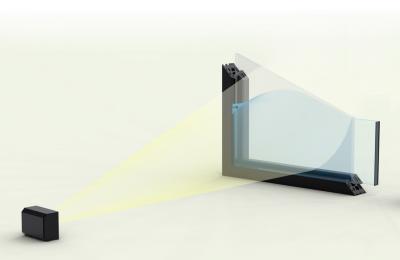
A novel motion sensor developed by the Fraunhofer Institutes for Applied Polymer Research IAP in Potsdam-Golm and for Computer Architecture and Software Technology FIRST in Berlin could enable window panes and glass doors to detect movements, thanks to a new pecial coating.
If anything changes in front of the pane, or someone sneaks up to it, an alarm signal is sent to the security guard.
Your cat is going to have a lot of fun with that, right? Luckily, threshold for the alarm can be set, so that small moving objects do not trigger an alarm.
Tiny creatures at the bottom of the food chain called diatoms suck up nearly a quarter of the atmosphere's carbon dioxide, yet research by Michigan State University scientists suggests they could become less able to "sequester" that greenhouse gas as the climate warms. The microscopic algae are a major component of plankton living in puddles, lakes and oceans.
Zoology professor Elena Litchman, with MSU colleague Christopher Klausmeier and Kohei Yoshiyama of the University of Tokyo, explored how nutrient limitation affects the evolution of the size of diatoms in different environments. Their findings underscore potential consequences for aquatic food webs and climate shifts.
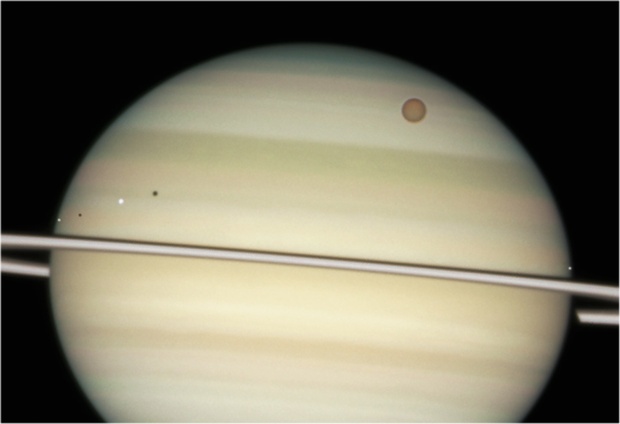
The Hubble Space Telescope recently captured a photo sequence of four moons of Saturn passing in front of their parent planet. The moons, from far left to far right, are icy white Enceladus and Dione, the large orange moon Titan, and icy Mimas. Due to the angle of the Sun, they are each preceded by their own shadow.
Though the popular conception has been that "money can't buy happiness," studies have shown that wealth can play a role in enhancing happiness. A study of American woman by a Princeton University psychologist says money doesn't buy happiness - not caring about having no money apparently makes the difference.
Women who concentrated on financial matters were less likely to be happy with their lives, according to Talya Miron-Shatz, a postdoctoral research fellow in the Woodrow Wilson School of Public and International Affairs at Princeton, even though they had plenty of money by conventional standards.
Conversely, those who didn't fixate on finances like retirement savings, tuition for college or simply making ends meet, reported being the happiest of the group.
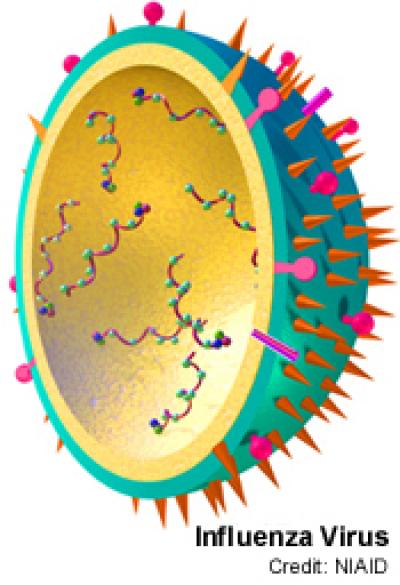
A new computerized method of testing could help world health officials better identify flu vaccines that are effective against multiple strains of the disease. Rice University scientists who created the method say tests of data from bird flu and seasonal flu outbreaks suggest their method can better gauge the efficacy of proposed vaccines than can tests used today.
Synchronized, goal-directed actions are nothing new; that concept is the foundation of civilization. But it goes much deeper than previously realized, according to research in BMC Neuroscience. It isn't just voluntary cooperation that happens, sometimes it is at the unconscious brain level.
A new study shows that when musicians play along together it isn't just their instruments that are working together, it is happening at the brain wave level also. The research details how EEG readouts from pairs of guitarists become more synchronized, a finding with wider potential implications for how our brains interact when we do.


 Pilot Study: Fibromyalgia Fatigue Improved By TENS Therapy
 High Meat Consumption Linked To Lower Dementia Risk
 Long Before The Inca Colonized Peru, Natives Had A Thriving Trade Network
 Mesolithic People Had Meals With More Tradition Than You Thought