Banner
Pilot Study: Fibromyalgia Fatigue Improved By TENS Therapy

Fibromyalgia is the term for a poorly-understood condition where people experience pain and fatigue...

High Meat Consumption Linked To Lower Dementia Risk

Older people who eat large amounts of meat have a lower risk of dementia and cognitive decline...

Long Before The Inca Colonized Peru, Natives Had A Thriving Trade Network

A new DNA analysis reveals that long before the Incan Empire took over Peru, animals were...

Mesolithic People Had Meals With More Tradition Than You Thought

The common imagery of prehistoric people is either rooting through dirt for grubs and picking berries...

User picture.
News StaffRSS Feed of this column.

News Releases From All Over The World, Right To You... Read More »

Blogroll
That guy who gets in the elevator reeking of Drakkar Noir is nothing new - the Ancient Egyptians cherished their fragrant scents, too.   In a new part of its permanent exhibition, Bonn University's Egyptian Museum has on display a particularly well preserved example of that.

Screening this 3,500-year-old flacon with a computer tomograph, scientists at the university detected the desiccated residues of a fluid, which they now want to submit to further analysis. They might even succeed in reconstructing this scent.
In the early parts of the decade, German and British intelligence said that Iraq had acquired weapons of mass destruction and were on their way to nuclear capability.    The American CIA agreed.    Saddam Hussein, in maybe the stupidest bluff of this century (there's still a long way to go), refused to let UN inspectors investigate thoroughly, perhaps thinking if the world believed he had nuclear capability, they would lift sanctions.    His mistakes cost him a wealthy dictatorship (though gold painted fixtures remain a puzzle to anyone who visits his many palaces) and, eventually, his life.
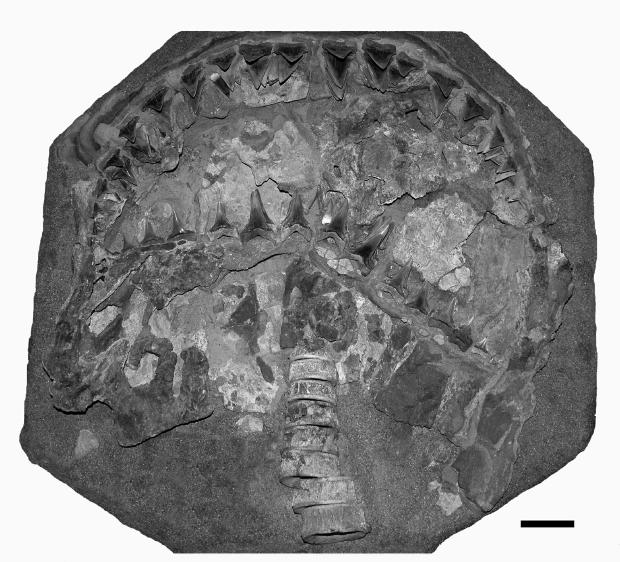
Sharks are among the most popular animals featured in television and cinema. And today among sharks, the undisputed king is the great white, a giant predator that can exceed 20 feet in length. Despite the popularity of great whites, relatively little is known about their biology, and even less is known about their evolutionary origins. A new 4-million-year-old fossil from Peru described in the Journal of Vertebrate Paleontology provides important evidence suggesting the shark’s origins may be more humble than previously believed.
If the Higgs boson, whatever that will turn out to be, is hiding, wherever it may be found continues to shrink.

The latest analysis of data from the CDF and DZero collider experiments at Fermilab has now excluded a significant fraction of the allowed Higgs mass range established by earlier measurements. Those experiments predict that the Higgs particle should have a mass between 114 and 185 GeV/c2. Now the CDF and DZero results carve out a section in the middle of this range and establish that it cannot have a mass in between 160 and 170 GeV/c2.

It seems obvious; even in a noble profession like education, if you pay people more who are better at it, better people are incentivized to do it. Obviously a number of people do it despite the money, just like science and academia, and the overall quality of education has improved a lot this decade but America has a way to go if we are going to keep at the forefront of science and technology in the face of huge populations in China and India.

But there has been resistance to that from educational lobbyists and a hardline union that only votes Democrat, which has unfortunately made education a political football.

Nyiragongo, an active African volcano, possesses lava unlike any other in the world, which may point toward its source being a new mantle plume says a University of Rochester geochemist.

The lava composition indicates that a mantle plume—an upwelling of intense heat from near the core of the Earth—may be bubbling to life beneath the soil of the Democratic Republic of the Congo. The findings are presented in the current issue of the journal Chemical Geology.