Banner
Pilot Study: Fibromyalgia Fatigue Improved By TENS Therapy

Fibromyalgia is the term for a poorly-understood condition where people experience pain and fatigue...

High Meat Consumption Linked To Lower Dementia Risk

Older people who eat large amounts of meat have a lower risk of dementia and cognitive decline...

Long Before The Inca Colonized Peru, Natives Had A Thriving Trade Network

A new DNA analysis reveals that long before the Incan Empire took over Peru, animals were...

Mesolithic People Had Meals With More Tradition Than You Thought

The common imagery of prehistoric people is either rooting through dirt for grubs and picking berries...

User picture.
News StaffRSS Feed of this column.

News Releases From All Over The World, Right To You... Read More »

Blogroll

Women with certain gene variations appear to be protected against cervical cancer, according to a study led by scientists at Albert Einstein College of Medicine of Yeshiva University and reported in Clinical Cancer Research. Knowing whether or not women have these genetic variants could help physicians to better tailor treatment strategies.

Virtually all cases of cervical cancer are caused by persistent infections from several of the human papillomaviruses (HPV) — a family of viruses that also cause common skin warts and genital warts. HPV is the most commonly sexually transmitted infection in young adults, yet only a small subset of these infections lead to cervical cancer.

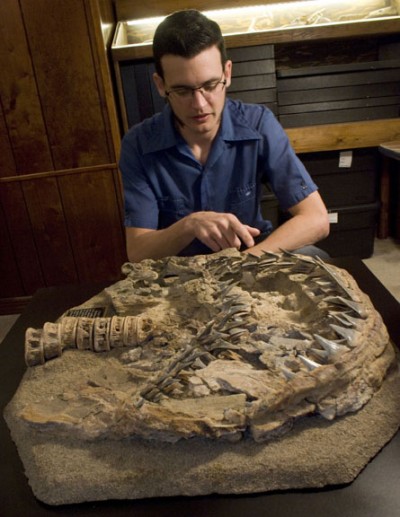
Want to start an argument among shark paleontologists?   Ask whether Carcharodon carcharias, the great white shark, evolved from the line that produced Carcharodon megalodon, the largest carnivorous fish known, or from the broad-toothed mako shark.

The mako camp contends megalodon, which grew to a length of 60 feet, should have its genus name switched to Carcharocles to reflect its different ancestry.  A study in the Journal of Vertebrate Paleontology says the mako proponents are right and concludes megalodon and modern white sharks are much more distantly related than paleontologists initially believed.
A new dating method found that "Peking Man" is around 200,000 years older than previously thought.  So how did he adapt to the cold of even a mild glacial period?

The Zhoukoudian, China, site of the remains of Homo erectus, commonly known as "Peking Man", was found to be 680,000-780,000 years old. Earlier estimates put the age at 230,000-500,000 years old.

Homo erectus is considered to be the ancestor species to humans and the first species that left Africa and moved into Asia. The "Peking Man" site, discovered in the late 1920s, was among the first found for Homo erectus and shaped the thoughts on the age and behavior of the species.
Researchers have found evidence suggesting that stars rich in carbon complex molecules may form at the center of our Milky Way galaxy - and it helps solve a mystery.   Namely, why have telescopes never detected carbon-rich stars at the center of our galaxy even though they have found these stars in other places?

This discovery is also significant because it adds to our knowledge of how stars form heavy elements like oxygen, carbon and iron and and then blow them out across the universe, making it possible for life to develop.
Researchers in Japan have turned to mathematics to build a computerized 3D model of the female trunk that could help lingerie and other clothes designers make more sensuous, comfortable, and better fitting product ranges.

According to Kensuke Nakamura of Kyoto Institute of Technology and Takao Kurokawa of Osaka University, identifying body shape components is critical for designing close-fitting products, whether underwear, everyday clothes, or safety garments.
Research at the new School of Creative Arts Therapies at the University of Haifa: Drawing enhances emotional verbalization among children who live under the shadow of drug-addicted fathers 

"The use of art seems to help with verbalizing trauma. It is usually difficult to express the trauma through speech, yet the body remembers it," said Prof. Rachel Lev-Wiesel, Head of the Graduate School of Creative Arts Therapies who carried out the study.