Banner
Pilot Study: Fibromyalgia Fatigue Improved By TENS Therapy

Fibromyalgia is the term for a poorly-understood condition where people experience pain and fatigue...

High Meat Consumption Linked To Lower Dementia Risk

Older people who eat large amounts of meat have a lower risk of dementia and cognitive decline...

Long Before The Inca Colonized Peru, Natives Had A Thriving Trade Network

A new DNA analysis reveals that long before the Incan Empire took over Peru, animals were...

Mesolithic People Had Meals With More Tradition Than You Thought

The common imagery of prehistoric people is either rooting through dirt for grubs and picking berries...

User picture.
News StaffRSS Feed of this column.

News Releases From All Over The World, Right To You... Read More »

Blogroll
Two highly lethal viruses that have emerged in recent outbreaks are susceptible to chloroquine, an established drug used to prevent and treat malaria, according to a new basic science study by researchers at Weill Cornell Medical College in the Journal of Virology.

The two henipaviruses that are the subject of the study -- Hendra Virus (HeV) and Nipah Virus (NiV) -- emerged during the 1990s in Australia and Southeast Asia. Harbored by fruit bats, they cause potentially fatal encephalitis and respiratory disease in humans, with a devastating 75 percent fatality rate. More recently, NiV outbreaks in Bangladesh involving human-to-human transmission have focused attention on NiV as a global health concern.
Scientists identified seven new species of bamboo coral discovered in the deep waters of the Papahānaumokuākea Marine National Monument. Six of these species may represent entirely new genera, a remarkable feat given the broad classification a genus represents. A genus is a major category in the classification of organisms, ranking above a species and below a family. Scientists expect to identify more new species as analysis of samples continues.
   
Overweight children and adolescents, with the active involvement of their parents and families, can successfully lose weight.

People are not biologically inclined to have a particular food addiction so patience and support are key but so is recognizing that it won't happen unless the kids are determined to change and they get some help; parents who have always bought junk food, for example, need to stop.  And kids who may have always had an unhealthy lifestyle need to recognize that and make some changes.

A team of experts that includes physicians and psychologists propose a new model of care for treating childhood and teen obesity which includes dietary, fitness, and lifestyle changes, education, and as a final option, if needed, surgery.
Scientists at the Sol Goldman Pancreatic Cancer Research Center at the Johns Hopkins Kimmel Cancer Center have used "personalized genome" sequencing on an individual with a hereditary form of pancreatic cancer to locate a mutation in a gene called PALB2 that is responsible for initiating the disease. The discovery marks their first use of a genome scanning system to uncover suspect mutations in normal inherited genes.

The coding error in PALB2, which stands for "partner and co-localizer of BRCA2" causes a shortened version of the protein encoded by this gene, rendering it incapable of working with another cancer-related gene, BRCA2, to repair broken DNA. Mutations in BRCA2 are also known to cause hereditary forms of cancer. 
In the past two years, University of Texas Southwestern researchers have used a computer-based text-searching tool they developed, called eTBLAST, to analyze millions of abstracts randomly selected from Medline, one of the largest databases of biomedical research articles. They turned up nearly 70,000 highly similar citations.

Their subsequent analysis of a small sampling of these, including human inspection of the articles in question, revealed 207 pairs of articles with signs of potential plagiarism. 

In a commentary appearing in Science, the UT Southwestern researchers outline the wide range of reactions they received when they followed up with both victims and perpetrators of possible misconduct, as well as responses from journal editors. 
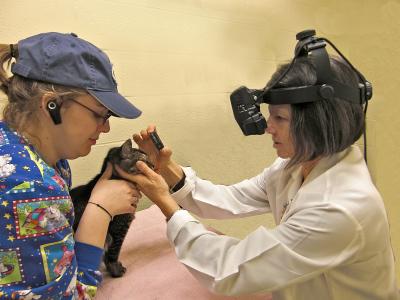
About one in 3,500 people are affected with retinitis pigmentosa (RP), a disease of the retina's visual cells that eventually leads to blindness. Now, a University of Missouri researcher has identified a genetic link between cats and humans for two different forms of RP. This discovery will help scientists develop gene-based therapies that will benefit both cats and humans. 

Researchers examined the genetic mutations in two groups of cats; one with a congenital form of RP and another with a late-onset form and were able to identify the genes responsible for both forms of the disease in cats.