Coastal erosion has more than doubled in Alaska – up to 45 feet per year – in a 5-year period between 2002 and 2007 along a 40-mile stretch of the Beaufort Sea, according to a U.S. Geological Survey(USGS) study that says average annual erosion rates along this part of the Beaufort Sea climbed from historical levels of about 20 feet per year between the mid-1950s and late-1970s, to 28 feet per year between the late-1970s and early 2000s, to a rate of 45 feet per year between 2002 and 2007.
Self-control is one of our most cherished values; we applaud those with the discipline to regulate their appetites and actions and we try hard to instill this virtue in our children. But is it possible that willpower can sometimes be an obstacle rather than a means to happiness and harmony?
Yes, say Tufts University psychologists Evan Apfelbaum and Samuel Sommers, who were intrigued by the notion that too much self-control may have a downside and that relinquishing some power might be paradoxically tonic, both for individuals and for society.
Globally, tropical trees in undisturbed forest are absorbing nearly a fifth of the CO2 released by burning fossil fuels, according to a 40-year study of African tropical forests published in Nature.
The researchers says that remaining tropical forests remove a massive 4.8 billion tons of CO2 emissions from the atmosphere each year. This includes a previously unknown carbon sink in Africa, mopping up 1.2 billion tons of CO2 each year. The African tropical forests – one third of the world's total tropical forest – has trapped an extra 0.6 tons of carbon per year in each hectare of intact African forest, they state.
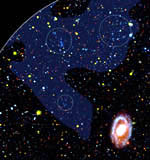
Evidence of star birth within a cloud of primordial gas has given astronomers a glimpse of a previously unknown mode of galaxy formation. The cloud, known as the Leo Ring, appears to lack the dark matter and heavy elements normally found in galaxies today. The unexpected discovery comes thanks to instruments aboard NASA’s Galaxy Evolution Explorer (GALEX) spacecraft which are sensitive to the ultraviolet radiation emitted by newly formed stars.
A congressionally mandated report from the National Research Council finds serious deficiencies in the nation's forensic science system and calls for major reforms and new research. Rigorous and mandatory certification programs for forensic scientists are currently lacking, the report says, as are strong standards and protocols for analyzing and reporting on evidence. And there is a dearth of peer-reviewed, published studies establishing the scientific bases and reliability of many forensic methods. Moreover, many forensic science labs are underfunded, understaffed, and have no effective oversight.
A study from the Harokopio University of Athens (Greece) says that adherence to a dietary pattern close to the Mediterranean diet, with high consumption of fish and olive oil and low red meat intake, has a significant impact in women skeletal health.
Results suggest that this eating pattern could have bone-preserving properties throughout adult life.
Diet is one of the modifiable factors for the development and maintenance of bone mass. The nutrients of most obvious relevance to bone health are calcium and phosphorus because they compose roughly 80% to 90% of the mineral content of bone; protein, other minerals and vitamins are also essential in bone preservation.


 Pilot Study: Fibromyalgia Fatigue Improved By TENS Therapy
 High Meat Consumption Linked To Lower Dementia Risk
 Long Before The Inca Colonized Peru, Natives Had A Thriving Trade Network
 Mesolithic People Had Meals With More Tradition Than You Thought