Taking up valuable land and growing edible crops for biofuels poses a dilemma: Is it ethical to produce inefficient renewable energies at the expense of an already malnourished population? David Pimentel and colleagues from Cornell University highlight the problems linked to converting a variety of crops into biofuels. Not only are these renewable energies inefficient, they are also economically and environmentally costly and nowhere near as productive as projected.
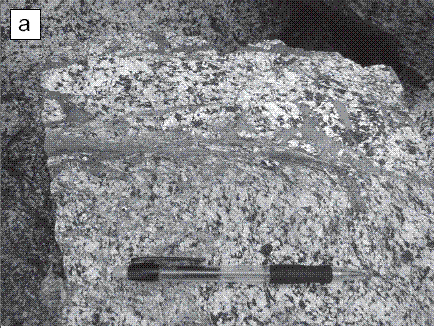
Rocks formed only under the extreme heat and friction during earthquakes, called pseudotachylytes, may be more abundant than previously reported, according to new research focused on eight faults found in the Sierra Nevada. The research appears in the February issue of the Bulletin of the Seismological Society of America.
Geologists have previously debated whether these rocks are rarely produced or not based on an apparent absence in the rock record, most likely brought about by the difficulty in identifying them. Only a small fraction of the energy released in an earthquake is consumed by seismic waves, the formation of pseudotachylytes reveals the importance of the heat generated by the earthquake process.
How the brain keeps tabs on what happened and when is still a matter of speculation but a computational model developed by scientists at the Salk Institute for Biological Studies now suggests that newborn brain cells—generated by the thousands each day—add a time-related code, which is unique to memories formed around the same time.
They didn't set out to explain how the brain stores temporal information but were interested in why adult brains continually spawn new brain cells in the dentate gyrus, the entryway to the hippocampus. The hippocampus, a small seahorse-shaped area of the brain, distributes memory to appropriate storage sections in the brain after readying the information for efficient recall.
Is it possible to share a pain that you observe in another but have never actually experienced yourself? A new study uses brain-imaging to try and answer this question and the research, published in Neuron, may provide insight into the brain mechanisms involved in empathy.
Brain-imaging studies have shown similar patterns of brain activity when subjects feel their own emotions or observe the same emotions in others. It has been suggested that a person who has never experienced a specific feeling would have a difficult time directly empathizing with a person through a "mirror matching" mechanism that requires previous experience and would instead have to rely on a higher inferential processes called "perspective taking."
Triceratops had three horns but it was not just to impress the females, says a research study led by Andrew Farke, curator at the Raymond M. Alf Museum of Paleontology, located on the campus of The Webb Schools. They used them to settle disputes as wel. Battle scars on the skulls of Triceratops preserve rare evidence of Cretaceous-era combat, they say.
Plants' ability to sprout upward using their own woody tissues has
long been considered one of the characteristics separating the land kind from aquatic plants, which rely on water to support them.


 Pilot Study: Fibromyalgia Fatigue Improved By TENS Therapy
 High Meat Consumption Linked To Lower Dementia Risk
 Long Before The Inca Colonized Peru, Natives Had A Thriving Trade Network
 Mesolithic People Had Meals With More Tradition Than You Thought