The International Year of Astronomy 2009 (IYA2009) has been launched by the International Astronomical Union (IAU) and the United Nations Educational, Scientific and Cultural Organization (UNESCO) under the theme, “The Universe, yours to discover”. Thousands of IYA2009 events are described on the national websites, as well as on astronomy2009.org, and a few of the global projects are listed here.
Riki Ellison, Chairman of the Missile Defense Advocacy Alliance (MDAA)
www.missiledefenseadvocacy.org points out in an Alert to the membership of his organization that the situation in the Middle East between Israel and the Hamas is a real life example of the need for missile defense deployment by Israel. Ellison was in Israel a few months ago and toured many of the cities under attack by Hamas. He has a good understanding of the need for a missile defense system for Israel, and shares this with the MDAA membership. His remarks are as follows:
Across the University of Colorado at Boulder campus students are sharing answers, checking their responses to questions against those of their neighbors and making adjustments to those answers in hopes of earning a better grade.
Not surprisingly, the students are getting more answers right. But what may be startling is that professors are encouraging the whole thing.
A team of Johns Hopkins neuroscientists has worked out how some newly discovered light sensors in the eye detect light and communicate with the brain. The report appears online this week in Nature.
These light sensors are a small number of nerve cells in the retina that contain melanopsin molecules. Unlike conventional light-sensing cells in the retina—rods and cones—melanopsin-containing cells are not used for seeing images; instead, they monitor light levels to adjust the body's clock and control constriction of the pupils in the eye, among other functions.
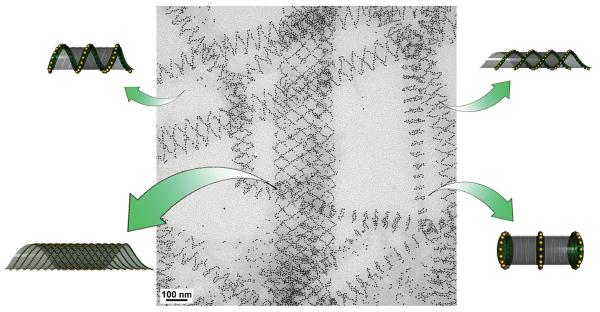
The future of the nanotechnology field depends on our ability to reliably and reproducibly assemble nanoparticles into 3D structures we can use to develop new technologies. According to Hao Yan and Yan Liu at Arizona State University, the greatest challenges in this burgeoning field include control over nanoscale 3D structure and imaging these tiny materials.
"The ability to build predicted structures and provide experimental feedback to current theories is critical to the nanotechnology field," said Yan.
One approach to production of nanoscale architecture is creation of nanoparticles that assemble themselves into the desired structure. DNA molecules are an elegant biological example of small particles that self-assemble to form higher order 3D structures.
Abundant tiny particles of diamond dust exist in sediments dating to 12,900 years ago at six North American sites, adding strong evidence for Earth’s impact with a rare swarm of carbon-and-water-rich comets or carbonaceous chondrites, reports a nine-member scientific team.
These nanodiamonds, which are produced under high-temperature, high-pressure conditions created by cosmic impacts and have been found in meteorites, are concentrated in similarly aged sediments at Murray Springs, Ariz., Bull Creek, Okla., Gainey, Mich., and Topper, S.C., as well as Lake Hind, Manitoba, and Chobot, Alberta, in Canada. Nanodiamonds can be produced on Earth, but only through high-explosive detonations or chemical vaporization.


 Pilot Study: Fibromyalgia Fatigue Improved By TENS Therapy
 High Meat Consumption Linked To Lower Dementia Risk
 Long Before The Inca Colonized Peru, Natives Had A Thriving Trade Network
 Mesolithic People Had Meals With More Tradition Than You Thought