Banner
Pilot Study: Fibromyalgia Fatigue Improved By TENS Therapy

Fibromyalgia is the term for a poorly-understood condition where people experience pain and fatigue...

High Meat Consumption Linked To Lower Dementia Risk

Older people who eat large amounts of meat have a lower risk of dementia and cognitive decline...

Long Before The Inca Colonized Peru, Natives Had A Thriving Trade Network

A new DNA analysis reveals that long before the Incan Empire took over Peru, animals were...

Mesolithic People Had Meals With More Tradition Than You Thought

The common imagery of prehistoric people is either rooting through dirt for grubs and picking berries...

User picture.
News StaffRSS Feed of this column.

News Releases From All Over The World, Right To You... Read More »

Blogroll
A unique, patent-pending collection of microbes that can be used both for cleaning up the environment and addressing our energy needs has earned the U.S. Department of Energy's Savannah River National Laboratory kudos from a newsletter covering the rapidly expanding field of nanotechnology. 

Nanotech Briefs awarded SRNL's BioTiger™ a spot on its fourth annual Nano 50™ list, described as the top 50 technologies, innovators and products expected to revolutionize the industry. Nanotech Briefs will present the awards during the National Nano Engineering Conference, Nov. 12-13 in Boston. For more information, visit www.techbriefs.com/nano.
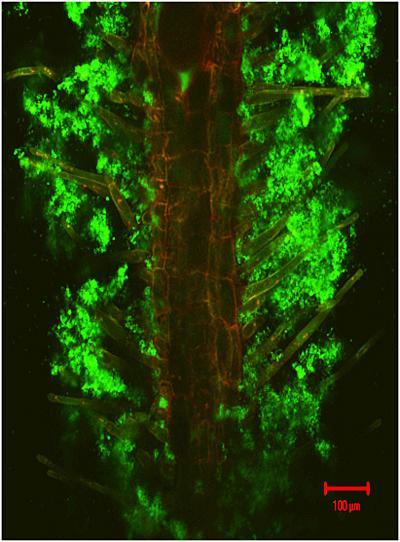
Researchers at the University of Delaware have discovered that when the leaf of a plant is under attack by a pathogen, it can send out an S.O.S. to the roots for help, and the roots will respond by secreting an acid that brings beneficial bacteria to the rescue.

The finding quashes the misperception that plants are "sitting ducks"--at the mercy of passing pathogens--and sheds new light on a sophisticated signaling system inside plants that rivals the nervous system in humans and animals.


The green represents the beneficial bacterium Bacillus subtilis, which has formed a biofilm on the Arabidopsis root surface.  Photo Credit: University of Delaware/Thimmaraju Rudrappa
A single molecule in the intestinal wall, activated by the waste products from gut bacteria, plays a large role in controlling whether the host animals are lean or fatty, a research team, including scientists from UT Southwestern Medical Center, has found in a mouse study.

When activated, the molecule slows the movement of food through the intestine, allowing the animal to absorb more nutrients and thus gain weight. Without this signal, the animals weigh less. 

The study shows that the host can use bacterial byproducts not only as a source of nutrients, but also as chemical signals to regulate body functions. It also points the way to a potential method of controlling weight, the researchers said.

According to a report by the UN Scientific Committee on the Effects of Atomic Radiation in 2000, patients are exposed to about 200 times more ionizing radiation than medical workers. In some countries, this figure can be nearly 500 times.

In the quest to discover the root of illnesses, patients have to undergo an increasing number of scans and tests that may involve the use of ionising radiation to detect the source and scope of an ailment. However, this practice could also put patients at risk.

"There has been concern that new technologies are not providing the amount of patient protection that medical professionals had expected.

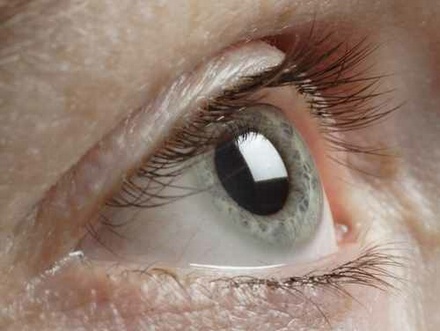
Massachusetts General Hospital (MGH) researchers have used gene therapy to restore useful vision to mice with degeneration of the light-sensing retinal rods and cones, a common cause of human blindness. Their report, appearing in the Oct. 14 Proceedings of the National Academy of Sciences, describes the effects of broadly expressing a light-sensitive protein in other neuronal cells found throughout the retina.

Two new articles examine the theory of "fetal programming" and their effect on racial health disparities. The studies, published in American Journal of Human Biology, suggest that the higher rates of hypertension and cardiovascular disease present in African Americans may be a consequence of low birth weights, and that these low birth weights may be a result of social rather than genetic factors.