Banner
Pilot Study: Fibromyalgia Fatigue Improved By TENS Therapy

Fibromyalgia is the term for a poorly-understood condition where people experience pain and fatigue...

High Meat Consumption Linked To Lower Dementia Risk

Older people who eat large amounts of meat have a lower risk of dementia and cognitive decline...

Long Before The Inca Colonized Peru, Natives Had A Thriving Trade Network

A new DNA analysis reveals that long before the Incan Empire took over Peru, animals were...

Mesolithic People Had Meals With More Tradition Than You Thought

The common imagery of prehistoric people is either rooting through dirt for grubs and picking berries...

User picture.
News StaffRSS Feed of this column.

News Releases From All Over The World, Right To You... Read More »

Blogroll

Lightning and gases from volcanic eruptions could have given rise to the first life on Earth, according to a new analysis of samples from a classic origin-of-life experiment by NASA and university researchers. The NASA-funded result is the subject of a paper in Science appearing October 16.

"Historically, you don't get many experiments that might be more famous than these; they re-defined our thoughts on the origin of life and showed unequivocally that the fundamental building blocks of life could be derived from natural processes," said lead author Adam Johnson, a graduate student with the NASA Astrobiology Institute team at Indiana University, Bloomington, Ind.

From 1953 to 1954, Professor Stanley Miller, then at the University of Chicago, performed a series of experiments with a system of closed flasks containing water and a gas of simple molecules. At the time, the molecules used in the experiment (hydrogen, methane, and ammonia) were thought to be common in Earth's ancient atmosphere.

Using brain imaging and chocolate milkshakes, scientists have found that women with weakened "reward circuitry" in their brains are at increased risk of weight gain over time and potential obesity. The risk increases even more for women who also have a gene associated with compromised dopamine signaling in the brain.

The results, drawn from two studies using functional magnetic resonance imaging (fMRI) at the University of Oregon's Lewis Center for Neuroimaging, appear in the Oct. 17 issue of the journal Science. The first-of-its-kind approach unveiled blunted activation in the brain's dorsal stratium when subjects were given milkshakes, which may reflect less-than-normal dopamine output.

Sunlight contains the entire spectrum of colors that can be seen with the naked eye -- all the colors of the rainbow. What our eyes interpret as color are really different energy levels, or frequencies of light. Today's solar cell materials can only capture a small range of frequencies, so they can only capture a small fraction of the energy contained in sunlight.

Researchers have created a new material that overcomes two of the major obstacles to solar power: it absorbs all the energy contained in sunlight, and generates electrons in a way that makes them easier to capture.

Ohio State University chemists and their colleagues combined electrically conductive plastic with metals including molybdenum and titanium to create the hybrid material.

For decades, scientists and resource managers have known that wildfires affect forest soils - in a direct sense because it kills vegetation and disrupts soil structure and then in an indirect sense because that then causes erosion. But, the lack of detailed knowledge of forest soils before they are burned by wildfire has hampered efforts to understand fire's effects on soil fertility and forest ecology.

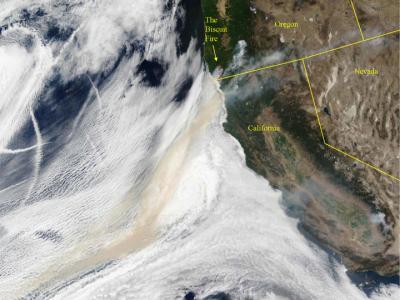
A new study led by the Pacific Northwest (PNW) Research Station addresses this critical information gap and represents the first direct evidence of the toll wildfire can take on forest soil layers. It draws on data from the 2002 Biscuit Fire, which scorched some 500,000 acres in southwest Oregon, including half of a pre-existing study's experimental plots, which had been studied extensively before the fire. The result was a serendipitous and unprecedented opportunity to directly examine how wildfire changes soil by sampling soils before and after a wildfire. The study appears in the November issue of the Canadian Journal of Forest Research.

Modern nuclear techniques are giving the world's scientists and regulators better tools to fight pollution and other environmental threats – even those that may be lurking naturally at the beach or near your backyard. Many of the world's top "radioecologists" are in Morocco this week to assess a dynamic picture.

Environmental protection is drawing more attention in countries at all stages of development. A special area is monitoring the presence and movement of radionuclides in nature -- many of which are associated with societal activities -- to track and prevent contamination of soils, water, air, and food.

Studies reported this week, for example, cover mining in Romania and Kenya, electricity generation in Spain and Serbia, waste disposal in Lithuania, well water pumping in the USA, coastal climate changes in Sweden, ocean studies in Turkey, air pollution monitoring in Morocco, and phosphate fertilizer use in Cuba. Associated environmental and radioactive elements include isotopes of radon, potassium, polonium, thorium, carbon, uranium, and lead.

Reports were presented at the 4th International Symposium on Nuclear Metrology as a Tool for Radioecology, being hosted in Rabat by Morocco's National Centre for Energy, Sciences and Nuclear Techniques (CNESTEN) with the support of the IAEA and other regional and global partners.

Many activities are outside the nuclear industry, and involve what are known as "naturally occurring radioactive materials" or NORM for short. The activities pose different levels of risk, and are regulated in different ways, sometimes not at all. Through its programmes, the IAEA is reviewing issues related to the management and regulation of NORM industries, with a view to developing additional guidance documents on specific activities.

"Human activities are increasingly having an impact on the environment," noted Francois Brechignac of the International Union of Radioecology in Morocco this week. "But we are too often reacting once the impacts are already there, sometimes too late to counteract environmental detriment."


In a series of experiments with sleeping mice, researchers at the Duke University Medical Center say they have shown that the part of the brain that processes scents is a key part of forming long-term memories, especially involving other individuals.

"We can all relate to the experience of walking into a room and smelling something that sparks a vivid, emotional memory about a family member from years or even decades ago," says Stephen Shea, Ph.D., the lead author of the study published in The Journal of Neuroscience. "This research sought to understand that phenomenon on a cellular level."

The researchers examined how strong memories are formed by creating new memories in the minds of mice while under sedation and monitoring their response to a memory-inducing stimulus afterwards, when they were awake.