Banner
Pilot Study: Fibromyalgia Fatigue Improved By TENS Therapy

Fibromyalgia is the term for a poorly-understood condition where people experience pain and fatigue...

High Meat Consumption Linked To Lower Dementia Risk

Older people who eat large amounts of meat have a lower risk of dementia and cognitive decline...

Long Before The Inca Colonized Peru, Natives Had A Thriving Trade Network

A new DNA analysis reveals that long before the Incan Empire took over Peru, animals were...

Mesolithic People Had Meals With More Tradition Than You Thought

The common imagery of prehistoric people is either rooting through dirt for grubs and picking berries...

User picture.
News StaffRSS Feed of this column.

News Releases From All Over The World, Right To You... Read More »

Blogroll

Think you knew spent too much time pondering the wonders of beer in college? These Rice University students have you beat. They're using genetic engineering to create beer that contains resveratrol, a chemical in wine that's been shown to reduce cancer and heart disease in lab animals.

Rice's "BioBeer" will be entered in the International Genetically Engineered Machine (iGEM) competition Nov. 8-9 in Cambridge, Mass. It's the world's largest synthetic biology competition, a contest where teams use a standard toolkit of DNA building blocks -- think genetic LEGO blocks -- to create living organisms that do odd things.

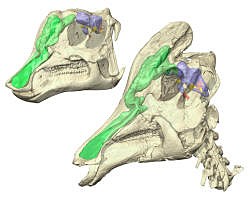
Paleontologists have long debated the function of the strange, bony crests on the heads of the duck-billed dinosaurs known as lambeosaurs. The structures contain incredibly long, convoluted nasal passages that loop up over the tops of their skulls.

Scientists at the University of Toronto, Ohio University and Montana State University now have used CT-scanning to look inside these mysterious crests and reconstruct the brains and nasal cavities of four different lambeosaur species.

At the annual meeting of the Society for Vertebrate Paleontology in Cleveland, Ohio, the team today announced new findings that suggest the crests were used for communication.

Eating too much fructose can induce leptin resistance, a condition that can easily lead to becoming overweight when combined with a high-fat, high-calorie diet, according to a new study with rats.

Although previous studies have shown that being leptin resistant can lead to rapid weight gain on a high-fat, high-calorie diet, this is the first study to show that leptin resistance can develop as a result of high fructose consumption. The study also showed for the first time that leptin resistance can develop silently, that is, with little indication that it is happening.

A team of researchers in Canada say they have made a bold stride in the struggle to detect dark matter - and it involves listening and WIMPS. The PICASSO collaboration has documented the discovery of a significant difference between the acoustic signals induced by neutrons and alpha particles in a detector based on superheated liquids.

Since neutron induced signals are very similar to dark matter induced signals, this new discovery published in the New Journal of Physics, could lead to improved background suppression in dark matter searches with this type of detector.

Physicists working to disprove "Lorentz invariance" -- Einstein's prediction that matter and massless particles will behave the same no matter how they're turned or how fast they go -- won't get that satisfaction from muon neutrinos, at least for the time being, says a consortium of scientists.

The test of Lorentz invariance, conducted by MINOS Experiment scientists and reported in the Oct. 10 issue of Physical Review Letters, started with a stream of muon neutrinos produced at Fermilab particle accelerator, near Chicago, and ended with a neutrino detector 750 meters away and 103 meters below ground. As the Earth does its daily rotation, the neutrino beam rotates too.

Scientists have detected long wavelength radio emissions from a colliding, massive galaxy cluster which, surprisingly, is not detected at the shorter wavelengths typically seen in these objects.

The discovery implies that existing radio telescopes have missed a large population of these colliding objects. It also provides an important confirmation of the theoretical prediction that colliding galaxy clusters accelerate electrons and other particles to very high energies through the process of turbulent waves.

This new population of objects is most easily detected at long wavelengths. Professor Greg Taylor of the University of New Mexico and scientific director of the Long Wavelength Array (LWA) points out, "This result is just the tip of the iceberg. When an emerging suite of much more powerful low frequency telescopes, including the LWA in New Mexico, turn their views to the cosmos, the sky will 'light up' with hundreds or even thousands of colliding galaxy clusters."