Banner
Pilot Study: Fibromyalgia Fatigue Improved By TENS Therapy

Fibromyalgia is the term for a poorly-understood condition where people experience pain and fatigue...

High Meat Consumption Linked To Lower Dementia Risk

Older people who eat large amounts of meat have a lower risk of dementia and cognitive decline...

Long Before The Inca Colonized Peru, Natives Had A Thriving Trade Network

A new DNA analysis reveals that long before the Incan Empire took over Peru, animals were...

Mesolithic People Had Meals With More Tradition Than You Thought

The common imagery of prehistoric people is either rooting through dirt for grubs and picking berries...

User picture.
News StaffRSS Feed of this column.

News Releases From All Over The World, Right To You... Read More »

Blogroll

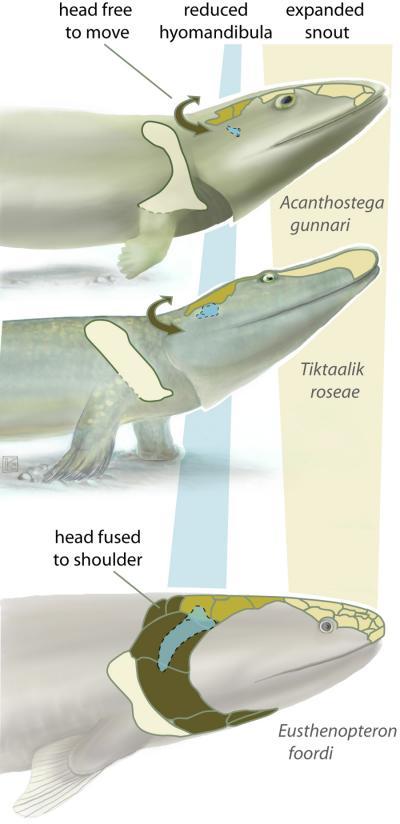
Newly exposed parts of Tiktaalik roseae--the intermediate fossil between fish and the first animals to walk out of water onto land 375 million years ago--are revealing how this major evolutionary event happened. A new study in Nature provides a detailed look at the internal head skeleton of Tiktaalik roseae and reveals a key intermediate step in the transformation of the skull that accompanied the shift to life on land by our distant ancestors.

A predator, up to nine feet long, with sharp teeth, a crocodile-like head and a flattened body, Tiktaalik's anatomy and way of life straddle the divide between fish and land-living animals. First described in 2006, and quickly dubbed the "fishapod," it had fish-like features such as a primitive jaw, fins and scales, as well as a skull, neck, ribs and parts of the limbs that are similar to tetrapods, four-legged animals.

Another multi-billion-dollar taxpayer bailout could lie ahead, this time to rescue a cash-strapped government program that insures pensions of 44 million American workers and retirees, a University of Illinois finance professor warns.

Jeffrey R. Brown says the troubled Pension Benefit Guaranty Corp., which steps in when private-sector employers with under funded defined-benefit plans go bankrupt, was $14 billion short of the cash it will need to cover pensions based on the latest estimates released a year ago.

But he predicts the shortfall will soar as a sour economy shutters more businesses and a plunging stock market carves into pension fund assets, with a government fix similar to this month's $700 billion Wall Street bailout as the likely solution.

People with autism-related disorders are less likely to make irrational decisions, and are less influenced by gut instincts, according to research funded by the Wellcome Trust. The study adds to the growing body of research implicating altered emotional processing in autism.

Decision-making is a complex process, involving both intuition and analysis: analysis involves computation and more "rational" thought, but is slower; intuition, by contrast, is much faster, but less accurate, relying on heuristics, or "gut instincts".

Hot, young planets may be easier to spot because they stay that way longer than astronomers have thought, according to new work by MIT planetary scientist Linda Elkins-Tanton.

For a few million years after their initial formation, planets like Earth may maintain a hot surface of molten rock that would glow brightly enough to make them stand out as they orbit neighboring stars. Elkins-Tanton, Mitsui Career Development Professor of Geology in the Department of Earth, Atmospheric and Planetary Sciences, says the “magma ocean” stage for Earth-sized planets may last a few million years, much longer than previously estimated. “That means we may actually see them elsewhere, as detection systems get better,” she said.

Schoolchildren, families and citizen scientists around the world will gaze skyward after dark from Oct. 20 to Nov.3, 2008, looking for specific constellations and then sharing their observations through the Internet.

The Great World Wide Star Count, now in its second year, helps scientists map light pollution globally while educating participants about the stars.

The event, which is open to everyone who wants to participate, is organized by the Windows to the Universe project at the University Corporation for Atmospheric Research (UCAR) in Boulder, Colo., in conjunction with planetariums and scientific societies across the country and abroad.

Yale Cancer Center researchers have identified a genetic biomarker that may help to determine why some people are at an increased risk of developing lung cancer.

The findings, published in the journal Cancer Research, could help identify smokers who should be carefully screened for lung cancer.

“Only 10% of smokers will develop lung cancer in their lifetime and genetic testing to determine the population of smokers who are most predisposed to develop the disease is needed to help guide better evaluation for these people,” explained Joanne B. Weidhaas, MD, PhD, assistant professor of therapeutic radiology at Yale School of Medicine and senior author on the study in collaboration with Frank Slack, PhD, associate professor in the department of molecular, cellular and developmental biology at Yale University.