Banner
Pilot Study: Fibromyalgia Fatigue Improved By TENS Therapy

Fibromyalgia is the term for a poorly-understood condition where people experience pain and fatigue...

High Meat Consumption Linked To Lower Dementia Risk

Older people who eat large amounts of meat have a lower risk of dementia and cognitive decline...

Long Before The Inca Colonized Peru, Natives Had A Thriving Trade Network

A new DNA analysis reveals that long before the Incan Empire took over Peru, animals were...

Mesolithic People Had Meals With More Tradition Than You Thought

The common imagery of prehistoric people is either rooting through dirt for grubs and picking berries...

User picture.
News StaffRSS Feed of this column.

News Releases From All Over The World, Right To You... Read More »

Blogroll

There was an idea first proposed in 1916 — that plants with rapid reproductive cycles evolve faster - and a team of Yale scientists writing in Science say they have confirmed it using 2008 computing power.

Long involved with the Tree of Life Web Project, which is attempting to reconstruct the “tree” representing the genealogical relationships of all species on Earth, Michael Donoghue, the G. Evelyn Hutchinson Professor of Ecology & Evolutionary Biology and Curator of Botany at Yale’s Peabody Museum of Natural History, has spearheaded the study of flowering plant evolution. In animals, the variation in rate of molecular evolution has been ascribed to differences in generation time, metabolic rate, DNA repair, and body size; in plants, the differences have been more difficult to determine.

Bacteria are everywhere and can survive in almost anything. Finding out exactly how bacteria respond and adapt to stresses and dangers will further our understanding of the basic survival mechanisms of some of the most resilient, hardy organisms on Earth.

Toward that goal, a bacteria cell's 'crisis command center' has been observed for the first time swinging into action to protect the cell from external stress and danger, according to new research out today.

It's like Team America: World Police, except there are no animatronic puppets or Alec Baldwin impressions.

The crisis command center in certain bacteria cells is a large molecule, dubbed a 'stressosome' by the scientists behind today's research.

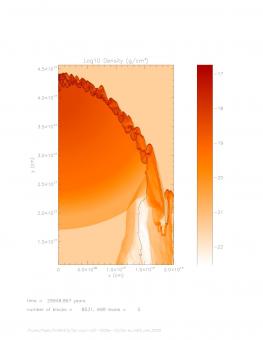
For several decades, scientists have thought that the Solar System formed as a result of a shock wave from an exploding star — a supernova — that triggered the collapse of a dense, dusty gas cloud that contracted to form the Sun and the planets.

Models of this formation process have only worked under the simplifying assumption that the temperatures during the violent events remained constant but astrophysicists at the Carnegie Institution’s Department of Terrestrial Magnetism (DTM) say their new model says that a supernova could indeed have triggered the Solar System’s formation under the more likely conditions of rapid heating and cooling.

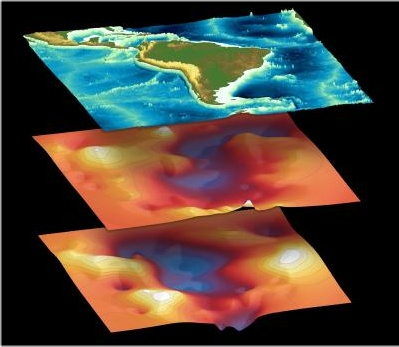
As the world looks for more energy, the oil industry will need more refined tools for discoveries in places where searches have never before taken place, geologists say. One such tool is a new sediment curve (which shows where sediment-on-the-move is deposited), derived from sediments of the Paleozoic Era 542 to 251 million years ago, scientists report in this week's Science. The sediment curve covers the entire Paleozoic Era.

"The sediment curve is of interest to industry, and also to scientists in academia," said Bilal Haq, lead author of the paper and a marine geologist at the National Science Foundation (NSF), "as the rise and fall of sea-level form the basis for intepretations of Earth history based on stratigraphy."

Belief in God encourages people to be helpful, honest and generous, but only under certain psychological conditions, according to University of British Columbia researchers who analyzed the past three decades of social science research.

Religious people are more likely than the non-religious to engage in prosocial behavior – acts that benefit others at a personal cost – when it enhances the individual's reputation or when religious thoughts are freshly activated in the person's mind, say UBC social psychologists Ara Norenzayan and Azim Shariff

A record two-hour observation of Jupiter using a new technique to remove atmospheric blur has produced the sharpest whole-planet picture ever taken from the ground. The series of 265 snapshots reveal changes in Jupiter's smog-like haze, probably in response to a planet-wide upheaval more than a year ago.

Being able to correct wide field images for atmospheric distortions has been a goal for decades. The new images of Jupiter prove the value of the advanced technology used by the Multi-Conjugate Adaptive Optics Demonstrator (MAD) prototype instrument mounted on ESO's Very Large Telescope (VLT), which uses two or more guide stars instead of one as references to remove the blur caused by atmospheric turbulence over a field of view thirty times larger than existing techniques.

Telescopes on the ground suffer from a blurring effect introduced by atmospheric turbulence. This turbulence causes the stars to twinkle in a way that delights the poets but frustrates the astronomers, since it smears out the fine details of the images. However, with Adaptive Optics (AO) techniques, this major drawback can be overcome so that the telescope produces images that are as sharp as theoretically possible, i.e., approaching conditions in space.