Banner
Pilot Study: Fibromyalgia Fatigue Improved By TENS Therapy

Fibromyalgia is the term for a poorly-understood condition where people experience pain and fatigue...

High Meat Consumption Linked To Lower Dementia Risk

Older people who eat large amounts of meat have a lower risk of dementia and cognitive decline...

Long Before The Inca Colonized Peru, Natives Had A Thriving Trade Network

A new DNA analysis reveals that long before the Incan Empire took over Peru, animals were...

Mesolithic People Had Meals With More Tradition Than You Thought

The common imagery of prehistoric people is either rooting through dirt for grubs and picking berries...

User picture.
News StaffRSS Feed of this column.

News Releases From All Over The World, Right To You... Read More »

Blogroll

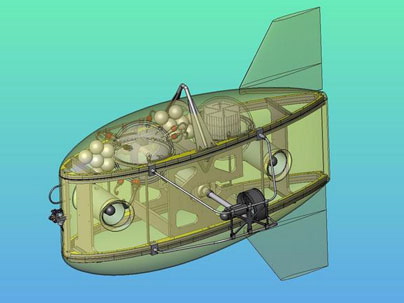
MIT researchers have designed a new robotic underwater vehicle that can hover in place like a helicopter — an invaluable tool for deepwater oil explorers, marine archaeologists, oceanographers and others.

The new craft, called Odyssey IV, is the latest in a series of small, inexpensive artificially intelligent submarines developed over the last two decades by the MIT Sea Grant College Program’s Autonomous Underwater Vehicles Laboratory. The Odyssey series revolutionized underwater research in the 1990s by introducing the thrifty and highly capable underwater robots. But the previous Odyssey vehicles still had one significant limitation: Like sharks, they could only operate while continuously moving forward.

How well students and schools succeed in mastering a curriculum that includes English Language Arts (ELA), mathematics, and the social and natural sciences, strongly influences how well the students fare in higher education. In California, student mastery in ELA and mathematics is measured with the California Standards Tests (CST).

Apparently, California is not doing very well. UC Riverside's Richard Cardullo examined several years of CST data and his mathematical models predict that nearly all elementary schools in California will fail to meet even the minimum requirements under the "No Child Left Behind Act of 2001" (NCLB) by 2014.

Over a decade after it exploded, one of the nearest supernovae in the last 25 years has been identified. This result was made possible by combining data from the vast online archives from many of the world’s premier telescopes.

The supernova, called SN 1996cr, was first singled out in 2001 by Franz Bauer. Bauer noticed a bright, variable source in the Circinus spiral galaxy, using NASA's Chandra X-ray Observatory. Although the source displayed some exceptional properties Bauer and his Penn State colleagues could not identify its nature confidently at the time.

It was not until years later that Bauer and his team were able to confirm that this object was a supernova. Clues from a spectrum obtained by ESO’s Very Large Telescope led the team to start the real detective work of searching through data from 18 different telescopes, both ground- and space-based, nearly all of which existed. Because this object was found in an interesting nearby galaxy, the public archives of these telescopes contained abundant observations.

Eight-year-old children have a much different learning strategy compared to twelve-year-olds and adults. Eight-year-olds learn primarily from positive feedback ('Well done!'), whereas negative feedback ('Got it wrong this time') scarcely causes any alarm bells to ring. Twelve-year-olds are better able to process negative feedback and learn from their mistakes. Adults do the same, but even more efficiently.

Dogs are often called "man's best friend," and rightly so because they never tell us we are wrong or interrupt us when we talk, are they are always happy to see us when we arrive home.

Some dogs take friendship to a whole other level by pulling us 1,100 miles in a race under the harshest conditions.

Since dogs became domesticated 15,000 years ago, they have worked with and lived next to humans, which may account for the special bond. While each of the 400 breeds and varieties have their fans, only racing sled dogs stand out as the ultra-athlete canine.

Today the new Global Carbon Budget was launched simultaneously by Global Carbon Project co-chair Michael Raupach in France at the Paris Observatory, and in the USA at Capitol Hill, Washington by GCP Executive Director Pep Canadell.

The Global Carbon Project posted the most recent figures for the worlds' carbon budget, a key to understanding the balance of carbon added to the atmosphere, the underpinning of human induced climate change. Despite the increasing international sense of urgency, the growth rate of emissions continued to speed up, bringing the atmospheric CO2 concentration to 383 parts per million (ppm) in 2007.