Banner
Pilot Study: Fibromyalgia Fatigue Improved By TENS Therapy

Fibromyalgia is the term for a poorly-understood condition where people experience pain and fatigue...

High Meat Consumption Linked To Lower Dementia Risk

Older people who eat large amounts of meat have a lower risk of dementia and cognitive decline...

Long Before The Inca Colonized Peru, Natives Had A Thriving Trade Network

A new DNA analysis reveals that long before the Incan Empire took over Peru, animals were...

Mesolithic People Had Meals With More Tradition Than You Thought

The common imagery of prehistoric people is either rooting through dirt for grubs and picking berries...

User picture.
News StaffRSS Feed of this column.

News Releases From All Over The World, Right To You... Read More »

Blogroll

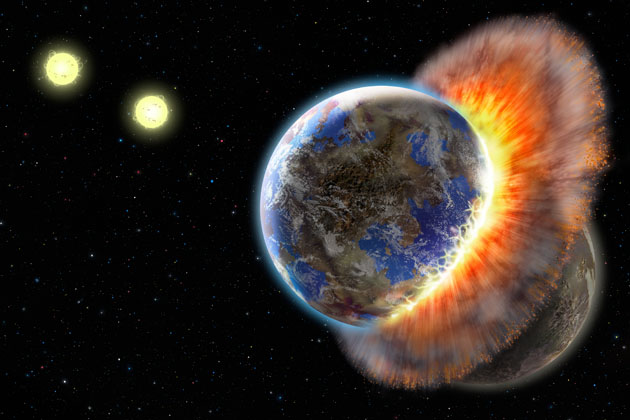
Two terrestrial planets in orbit around a sun-like star, BD +20 307, recently suffered a violent collision, astronomers at University of California Los Angeles, Tennessee State University, and California Institute of Technology will report in a December issue of the Astrophysical Journal, the premier journal of astronomy and astrophysics.

“It’s as if Earth and Venus collided with each other,” said Benjamin Zuckerman, UCLA professor of physics and astronomy and a co-author on the paper. “Astronomers have never seen anything like this before; apparently major, catastrophic, collisions can take place in a fully mature planetary system.”

After several years of detective work, philologists at the University of Stavanger in Norway have collected a unique collection of texts online and they're about to start the most comprehensive analysis of middle English ever.

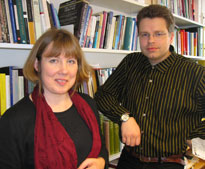
During the last few years, associate professor Merja Stenroos and post doctor Martti Mäkinen at the University of Stavanger have travelled around Britain and read original handwritten leather manuscripts from the 1300s–1500s.

"It is as natural for us in Stavanger to research Middle English as it is for English researchers. None of us have this language as our mother tongue anyway, says Merja Stenroos, who is managing the project titled MEG - Middle English Grammar.

 Merja Stenroos Martti Mäkinen  15th century Book of Hours Folio

Whether young people get drunk as a purposeful behavior or as an unintended consequence depends on what country they live in, according to new research on young people in seven countries. The research finds that young people's views on alcohol and drunkenness were influenced more by culture than by factors such as age and sex.

The research, sponsored by the International Center for Alcohol Policies (ICAP), also finds striking similarities about drinking among young people in different parts of the world including:

A nesting behavior study has detailed some previously unconsidered effects of biodiversity loss and climate change - changing seabird biodiversity is resulting in more ammonia in the atmosphere.

Ammonia emissions from seabirds have been shown to be a significant source of nitrogen in remote coastal ecosystems, contributing to nutrient enrichment (eutrophication) and acidification. While most ammonia emissions originate from domesticated animals such as poultry and pigs, seabirds are the most significant emitters of ammonia to the atmosphere in remote regions.

It sounds like an episode of MacGyver. What can you make from a lump of graphite, a piece of Scotch tape and a silicon wafer?

Cornell researchers didn't fly out off a cliff or blow up a door, they created the world's thinnest balloon - a membrane that is just one atom thick but strong enough to contain gases under several atmospheres of pressure without popping.

Unlike your average party balloon or even a thick, sturdy glass container, this membrane is ultra-strong, leak-proof and impermeable to even nimble helium atoms.

In a horror movie of the future, the villain could very well be someone who hijacks your GPS system and sends you to that lonely cabin in the woods.

Global positioning system (GPS) technology is becoming something people can't imagine living without, so if such a ubiquitous system were to come under attack, what could be done?

It's an uncomfortable question, but one that a group of Cornell researchers have considered with their research into "spoofing" GPS receivers.