Banner
Pilot Study: Fibromyalgia Fatigue Improved By TENS Therapy

Fibromyalgia is the term for a poorly-understood condition where people experience pain and fatigue...

High Meat Consumption Linked To Lower Dementia Risk

Older people who eat large amounts of meat have a lower risk of dementia and cognitive decline...

Long Before The Inca Colonized Peru, Natives Had A Thriving Trade Network

A new DNA analysis reveals that long before the Incan Empire took over Peru, animals were...

Mesolithic People Had Meals With More Tradition Than You Thought

The common imagery of prehistoric people is either rooting through dirt for grubs and picking berries...

User picture.
News StaffRSS Feed of this column.

News Releases From All Over The World, Right To You... Read More »

Blogroll

Arthroscopic surgery is widely accepted as an effective treatment for osteoarthritis of the knee. It's a minimally invasive surgical procedure involving insertion of an arthroscope and other instruments into the joint through small incisions in order to remove cartilage fragments and smooth the joint surfaces. Osteoarthritis is the most common form of arthritis affecting one in ten Canadians and 27 million Americans.

A landmark study conducted in London, Canada at The University of Western Ontario and Lawson Health Research Institute shows that a routinely practiced knee surgery is ineffective at reducing joint pain or improving joint function for sufferers of osteoarthritis. The study appears in the September 11th New England Journal of Medicine.

It sounds like common sense to say the level of nutrients in soil determines how many different kinds of plants and trees can thrive in an ecosystem, but it's only now that mathematicians have modelled all the different possible relationships between nutrients and biodiversity in lab-based experimental ecosystems.

Writing in Nature, they found that although nutrient availability definitely has an impact on biodiversity, the precise relationship between the two depends on which species are present in the ecosystem. This means that in some cases low levels of nutrients can lead to high levels of biodiversity.

Contrary to the national "carbon budgets" as outlined in the Kyoto Protocol, a new analysis in Nature suggests that old growth forests are "carbon sinks" and they continue to absorb carbon dioxide from the atmosphere and mitigate climate change for centuries.

Old growth forests around the world are not protected by international treaties and have been considered of no significance in the Kyoto Protocol. That perspective was largely based on findings of a single study from the late 1960s and these scientists now say it needs to be changed.

An analysis of 519 different plot studies found that about 15 percent of the forest land in the Northern Hemisphere is unmanaged primary forests with large amounts of old growth, and that rather than being irrelevant to the Earth's carbon budget, they may account for as much as 10 percent of the global net uptake of carbon dioxide.

What do you call a supernova that is not as powerful and doesn't destroy the star?

A babynova? Subnova?

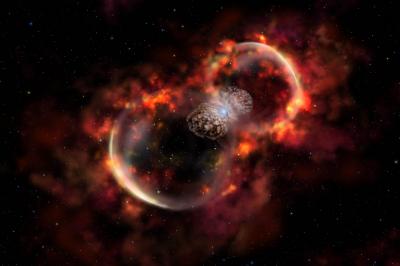
We'll need to think of something, according to Berkeley astronomer Nathan Smith, because that is what happened in 1843 to Eta Carinae, the galaxy's second most studied star.

Eta Carinae (η Car) is a massive, hot, variable star visible only from the Southern Hemisphere, and is located about 7,500 light years from Earth in a young region of star birth called the Carina Nebula. It was observed to brighten immensely in 1843, and astronomers now see the resulting cloud of gas and dust, known as the Homunculus nebula, wafting away from the star. A faint shell of debris from an earlier explosion is also visible, probably dating from around 1,000 years ago.

The first beam in the Large Hadron Collider at CERN was successfully steered around the full 27 kilometres of the world’s most powerful particle accelerator at 10h28 this morning. This historic event marks a key moment in the transition from over two decades of preparation to a new era of scientific discovery.

“It’s a fantastic moment,” said LHC project leader Lyn Evans, “we can now look forward to a new era of understanding about the origins and evolution of the universe.”

Starting up a major new particle accelerator takes much more than flipping a switch. Thousands of individual elements have to work in harmony, timings have to be synchronized to under a billionth of a second, and beams finer than a human hair have to be brought into head-on collision.

Researchers studying a critical stage of pregnancy – implantation of the embryo in the uterus – have found a protein that is vital to the growth of new blood vessels that sustain the embryo. Without this protein, which is produced in higher quantities in the presence of estrogen, the embryo is unlikely to survive.

This is the first study to detail the mechanism by which the steroid hormone estrogen spurs cell differentiation and blood-vessel growth in the uterus during pregnancy, the researchers report.

The findings, from researchers at the University of Illinois, Emory University, Baylor College of Medicine and New York University, appear in the journal Development.