Banner
Pilot Study: Fibromyalgia Fatigue Improved By TENS Therapy

Fibromyalgia is the term for a poorly-understood condition where people experience pain and fatigue...

High Meat Consumption Linked To Lower Dementia Risk

Older people who eat large amounts of meat have a lower risk of dementia and cognitive decline...

Long Before The Inca Colonized Peru, Natives Had A Thriving Trade Network

A new DNA analysis reveals that long before the Incan Empire took over Peru, animals were...

Mesolithic People Had Meals With More Tradition Than You Thought

The common imagery of prehistoric people is either rooting through dirt for grubs and picking berries...

User picture.
News StaffRSS Feed of this column.

News Releases From All Over The World, Right To You... Read More »

Blogroll

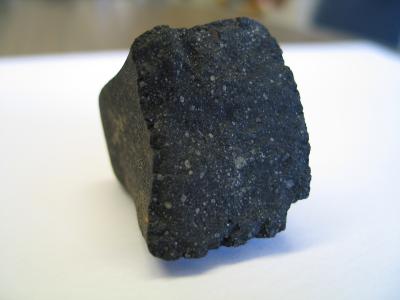
A strange mix of oxygen found in a stony meteorite that exploded February 8, 1969 over Pueblito de Allende, Mexico has puzzled scientists ever since. Small flecks of minerals lodged in the stone and thought to date from the beginning of the solar system have a pattern of oxygen types, or isotopes, that differs from those found in all known planetary rocks, including those from Earth, its Moon and meteorites from Mars.

Now scientists from UC San Diego and Lawrence Berkeley National Laboratory have eliminated one model proposed to explain the anomaly: the idea that light from the early Sun could have shifted the balance of oxygen isotopes in molecules that formed after it turned on. When they beamed light through carbon monoxide gas to form carbon dioxide, the balance of oxygen isotopes in the new molecules failed to shift in ways predicted by the model they report in the September 5 issue of Science.

Subtle genetic changes that confer an evolutionary advantage upon a species, such as the dexterity characteristic of the human hand, while difficult to detect and even harder to reproduce in a model system, have nevertheless generated keen interest amongst evolutionary biologists.

In findings published in Science, researchers have uncovered a specifically human 13-nucelotide change concealed in the vast three-billion-letter landscape of the human genome. Their experiments reveal this stretch of DNA to be a recently evolved regulator of gee expression that, when introduced into a mouse embryo system, influence the molecular machinery to yield human limb and thumb development patterns.

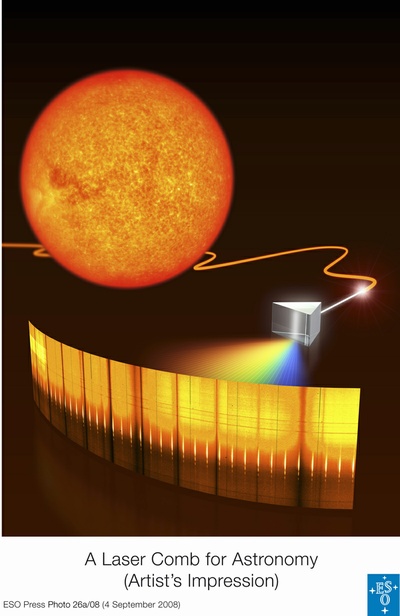
Astronomical instruments needed to answer crucial questions, such as the search for Earth-like planets or the way the Universe expands, have come a step closer with the first demonstration at the telescope of a new calibration system for precise spectrographs. The method uses a Nobel Prize-winning technology called a 'laser frequency comb', and is published in this week's issue of Science.

"It looks as if we are on the way to fulfil one of astronomers' dreams," says team member Theodor Hänsch, director at the Max Planck Institute for Quantum Optics (MPQ) in Germany. Hänsch, together with John Hall, was awarded the 2005 Nobel Prize in Physics for work including the frequency comb technique.

Binge drinking (5+ alcoholic beverages at one time) is associated with risky sexual behaviors. A new study is one of the few to examine this association by gender in an urban clinic for sexually transmitted diseases (STDs). Results show that binge drinking among women attending the clinic was linked to unsafe sexual practices – such as multiple partners and anal sex – and high rates of gonorrhea.

"The link between binge drinking and risky sexual behavior is complex," said Heidi E. Hutton, assistant professor of psychiatry and behavioral sciences at Johns Hopkins University School of Medicine as well as corresponding author for the study. "We wanted to examine one component of that relationship, whether binge drinking increased the risk of engaging in sexual behaviors and having STDs. We found gender differences in binge drinking among patients at an STD clinic, and also that binge drinking increased STD risk for women."

Bumblebees learn to avoid camouflaged predators by sacrificing foraging speed for predator detection, according to scientists from Queen Mary, University of London.

One of the bumblebee's main predators is the crab spider. Crab spiders hunt pollinating insects like bees and butterflies by lying in wait on flowers, and are particularly difficult for their prey to spot because they can change their colour to blend in with their surroundings.

Dr Tom Ings and Professor Lars Chittka from Queen Mary's School of Biological and Chemical Sciences wanted to discover whether bumblebees could learn to avoid these crab spiders. Their study, funded by the NERC and published in the journal Current Biology, shows how a run in with a spider affected the bees' foraging patterns.

Why is it that the origins of many serious diseases remain a mystery? In considering that question, a scientist at the University of California, San Diego School of Medicine has come up with a unified molecular view of the indivisible unit of life, the cell, which may provide an answer.

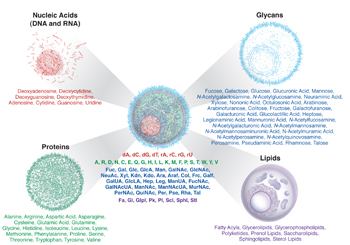
Reviewing findings from multiple disciplines, Jamey Marth, Ph.D., UC San Diego Professor of Cellular and Molecular Medicine and Investigator with the Howard Hughes Medical Institute, realized that only 68 molecular building blocks are used to construct these four fundamental components of cells: the nucleic acids (DNA and RNA), proteins, glycans and lipids. His work, which illustrates the primary composition of all cells, is published in the September issue of Nature Cell Biology.

Like the periodic table of elements, first published in 1869 by Russian chemist Dmitri Mendeleev, is to chemistry, Marth’s visual metaphor offers a new framework for biologists.