Banner
Pilot Study: Fibromyalgia Fatigue Improved By TENS Therapy

Fibromyalgia is the term for a poorly-understood condition where people experience pain and fatigue...

High Meat Consumption Linked To Lower Dementia Risk

Older people who eat large amounts of meat have a lower risk of dementia and cognitive decline...

Long Before The Inca Colonized Peru, Natives Had A Thriving Trade Network

A new DNA analysis reveals that long before the Incan Empire took over Peru, animals were...

Mesolithic People Had Meals With More Tradition Than You Thought

The common imagery of prehistoric people is either rooting through dirt for grubs and picking berries...

User picture.
News StaffRSS Feed of this column.

News Releases From All Over The World, Right To You... Read More »

Blogroll

Scientists at Michigan State University have identified a new protein necessary for chloroplast development that they say could ultimately lead to plant varieties tailored specifically for biofuel production.

Chloroplasts, which are specialized compartments in plant cells, convert sunlight, carbon dioxide and water into sugars and oxygen ("fuel" for the plant) during photosynthesis. The newly discovered protein, trigalactosyldiacylglycerol 4, or TGD4, offers insight into how the process works.

When a cell begins to multiply in a dangerously abnormal way, a series of death signals trigger it to self-destruct before it turns cancerous. In research in the August 15th issue of Genes & Development, Rockefeller University scientists using mice have figured out a way to amplify the signals that tell these precancerous cells to die. The trick: Inactivating a protein that normally helps cells to avoid self-destruction.

The work, led by Hermann Steller, Strang Professor and head of the Laboratory of Apoptosis and Cancer Biology, is the first to reveal the mechanism by which a class of proteins called IAPs regulates cell death. By exposing the mechanism in a living animal, the finding also marks a breakthrough in the field and opens the door for developing a new class of drugs that could aid in cancer therapy and prevention.

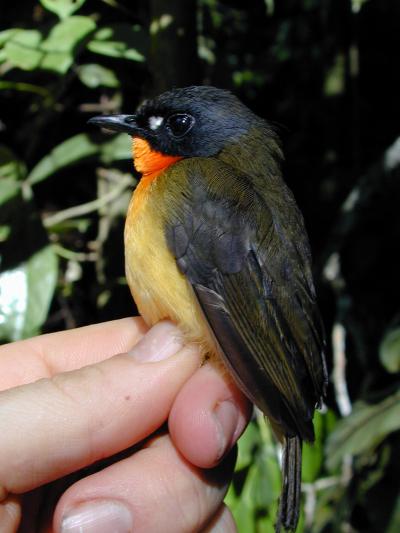
Scientists at the Smithsonian Institution have discovered a new species of bird in Gabon, Africa, that was, until now, unknown to the scientific community. Their findings were published in the international science journal Zootaxa today, Aug. 15.

The newly found olive-backed forest robin (Stiphrornis pyrrholaemus) was named by the scientists for its distinctive olive back and rump. Adult birds measure 4.5 inches in length and average 18 grams in weight. Males exhibit a fiery orange throat and breast, yellow belly, olive back and black feathers on the head. Females are similar, but less vibrant. Both sexes have a distinctive white dot on their face in front of each eye.

The bird was first observed by Smithsonian scientists in 2001 during a field expedition of the National Zoo's Monitoring and Assessment of Biodiversity Program in southwest Gabon. It was initially thought, however, to be an immature individual of an already-recognized species. Brian Schmidt, a research ornithologist at the Smithsonian's National Museum of Natural History and a member of the MAB program's team, returned to Washington, D.C., from Gabon in 2003 with several specimens to enter into the museum's bird collection. When he compared them with other forest robins of the genus Stiphrornis in the collection, Schmidt immediately noticed differences in color and plumage, and realized the newly collected birds might be unique.

In the world of alternative fuels, there may be nothing greener than pond scum.

Algae are tiny biological factories that use photosynthesis to transform carbon dioxide and sunlight into energy so efficiently that they can double their weight several times a day, producing oil in the process — 30 times more oil per acre than soybeans, according to the U.S. Department of Energy. Like soybean oil, the algae oil can be burned directly in diesel engines or further refined into biodiesel.

A new systematic analysis of the relationship between the neoplastic and developmental transcriptome provides an outline of trends in cancer gene expression. The research, published recently in Genome Biology, describes how cancers can be divided into three groups distinguished by disparate developmental signatures.

Isaac S Kohane from Children's Hospital Boston and Harvard University, US, led a team of researchers who performed a comprehensive comparison of genes expressed in early developmental stages of various human tissues and those expressed in different cancers affecting these tissues. He says, "Our study reveals potentially clinically relevant differences in the gene expression of different cancer types and represents a reference framework for interpretation of smaller-scale functional studies".

The NHS and private healthcare are not providing good enough basic care to a large portion of the population in England, especially older and frailer people, according to a study published on bmj.com today.

Overall, only 62% of the care recommended for older adults is actually received, conclude the authors.

The large-scale independent study of quality of care involved 8 688 people aged 50 and over and looked at 13 different health conditions including heart disease, diabetes, stroke, depression and osteoarthritis.