Banner
Pilot Study: Fibromyalgia Fatigue Improved By TENS Therapy

Fibromyalgia is the term for a poorly-understood condition where people experience pain and fatigue...

High Meat Consumption Linked To Lower Dementia Risk

Older people who eat large amounts of meat have a lower risk of dementia and cognitive decline...

Long Before The Inca Colonized Peru, Natives Had A Thriving Trade Network

A new DNA analysis reveals that long before the Incan Empire took over Peru, animals were...

Mesolithic People Had Meals With More Tradition Than You Thought

The common imagery of prehistoric people is either rooting through dirt for grubs and picking berries...

User picture.
News StaffRSS Feed of this column.

News Releases From All Over The World, Right To You... Read More »

Blogroll

Common genetic variations affecting nicotine receptors in the nervous system can significantly increase the chance that European Americans who begin smoking by age 17 will struggle with lifelong nicotine addiction, according to researchers at the University of Utah and their colleagues at University of Wisconsin-Madison.

The study highlights the importance of public health efforts to reduce the number of youth who begin smoking.

These common gene variations - single nucleotide polymorphisms (SNPs) - are changes in a single unit of DNA. SNPs that are linked and inherited together are called a haplotype. The researchers found that one haplotype for the nicotine receptor put European American smokers at greater risk of heavy nicotine dependence as adults, but only if they began daily smoking before the age of 17. A second haplotype actually reduced the risk of adult heavy nicotine dependence for people who began smoking in their youth.

Indiana Jones isn't the only one who has great adventures, apparently proteins do also. Researchers have uncovered a a slippery tube that funnels proteins into a 'chamber of doom' where they are shredded and recycled into the building blocks of new proteins.

The tube is part of the 26S proteasome, an enzyme that acts as the cell’s protein garbage disposal. As described by researchers from the Technion-Israel Institute of Technology and the University of Texas Health Science Center at San Antonio, the tube is a concentric stack of rings wrapped in molecular motors that speed the proteins toward the proteasome’s slicing and dicing core.

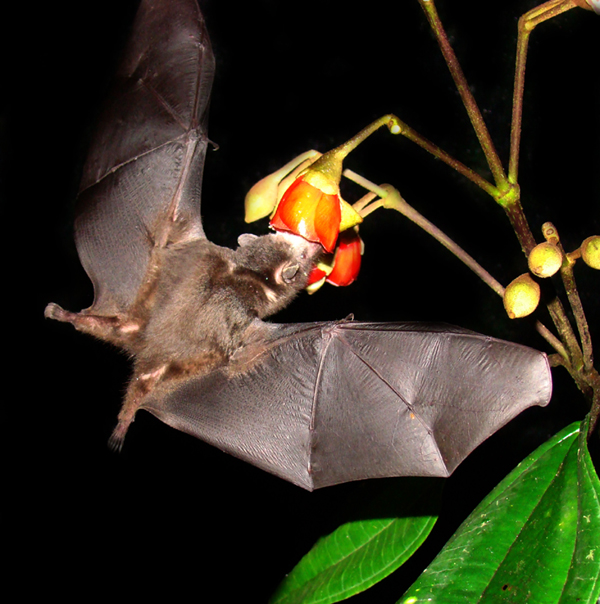
Bats, outnumbered only by rodents in number of species and thus the second largest group of mammals, are a remarkable evolutionary success story. Now they have gotten even more interesting. Researchers of the Leibniz-Institute for Zoo and Wildlife Research in Berlin (Germany) and Boston University (U.S.A.) have discovered a place that harbors the highest number of bat species ever recorded.

In just a few hectares of rainforest in the Amazon basin of eastern Ecuador, they have found more than 100 species of bats.

Dr. Katja Rex and colleagues captured bats at several biodiversity hotspots in the New World tropics, in the lowland rainforest of Costa Rica, the slopes of the Andes and a site in the Amazon rainforest of Eastern Ecuador, at the Tiputini Biodiversity Station located adjacent to the Yasuní Biosphere Reserve.

Fairbanks, Alaska—A 150-meter ice core pulled from the McCall Glacier in the Arctic National Wildlife Refuge this summer may offer researchers their first quantitative look at up to two centuries of climate change in the region.

The core, which is longer than 11/2 football fields, is the longest extracted from an arctic glacier in the United States, according to Matt Nolan, an associate professor at the University of Alaska Fairbanks Institute of Northern Engineering who has led research at McCall Glacier for the past six years. The sample spans the entire depth of the glacier and may cover 200 years of history, he said.

 A section of ice core shows bands of bubbles frozen within the ice of McCall Glacier.

The nation's fourth and eighth graders scored higher in reading and mathematics than they did during their last national assessment, according to the federal government's latest annual statistical report on the well-being of the nation's children. Not all the report's findings were positive; there also were increases in the adolescent birth rate and the proportion of infants born at low birthweight.

These and other findings are described in America's Children in Brief: Key National Indicators of Well-Being, 2008. The report is compiled by the Federal Interagency Forum on Child and Family Statistics, a working group of Federal agencies that collect, analyze, and report data on issues related to children and families, with partners in private research organizations. It serves as a report card on the status of the nation's children and youth, presenting statistics compiled by a number of federal agencies in one convenient reference.

The report: Fuel for thought – The future of transport fuels: challenges and opportunities addresses two serious issues – the need to dramatically reduce the transport sector's greenhouse gas emissions and, how to deal with the economic risks associated with increasingly costly and scarce oil supplies.

The report is the result of a year's deliberations by the Future Fuels Forum (FFF) which was convened by CSIRO to engage leading community, industry and government bodies in discussions about a range of plausible scenarios for establishing a secure and sustainable transport fuel mix to 2050.

Director of CSIRO's Energy Transformed Flagship, Dr John Wright, said Australia's transport fuel mix will substantially change in response to issues such as climate change and oil prices.