Banner
Pilot Study: Fibromyalgia Fatigue Improved By TENS Therapy

Fibromyalgia is the term for a poorly-understood condition where people experience pain and fatigue...

High Meat Consumption Linked To Lower Dementia Risk

Older people who eat large amounts of meat have a lower risk of dementia and cognitive decline...

Long Before The Inca Colonized Peru, Natives Had A Thriving Trade Network

A new DNA analysis reveals that long before the Incan Empire took over Peru, animals were...

Mesolithic People Had Meals With More Tradition Than You Thought

The common imagery of prehistoric people is either rooting through dirt for grubs and picking berries...

User picture.
News StaffRSS Feed of this column.

News Releases From All Over The World, Right To You... Read More »

Blogroll

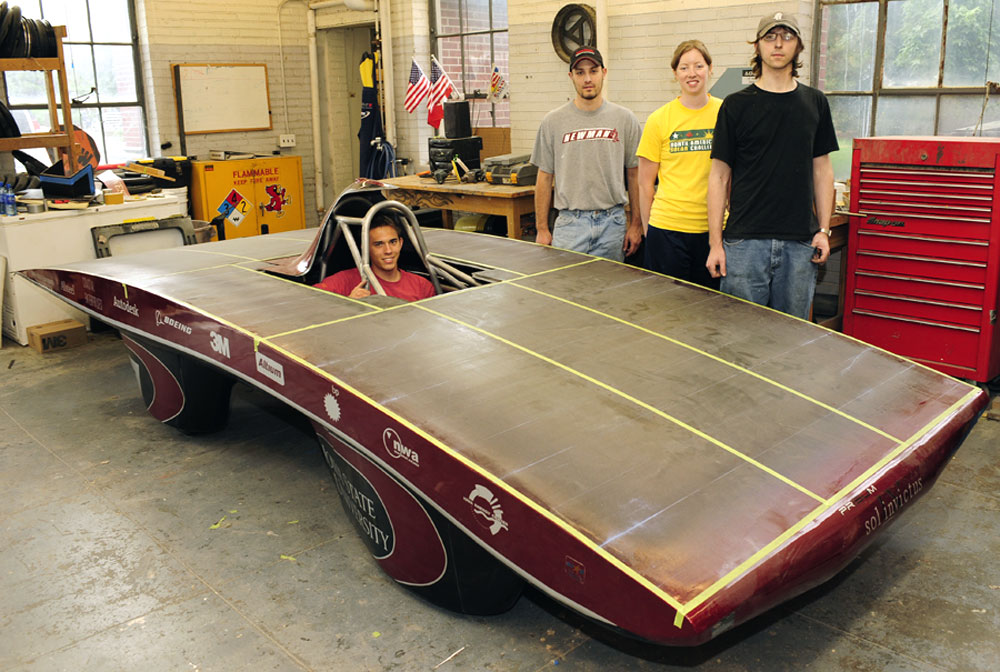
Sol Invictus, Iowa State University's student-designed and student-built solar race car, is getting ready to compete in the North American Solar Challenge July 13-22.

The challenge will take 24 student-designed and student-built solar race cars from Plano, Texas, to Calgary, Alberta, Canada. They’ll make the 2,400-mile run July 13-22, with a checkpoint in Omaha, Neb., July 15-16 and a stage stop in Sioux Falls, S.D., July 16-18. The route between those cities takes the solar cars into western Iowa for a few hours.

Team PrISUm did very well in 2005, the last time the challenge was contested. The Iowa State car made it from Austin, Texas, to Calgary in 71.5 hours. That was good for a third place finish in the challenge’s stock class and 11th overall against cars in the more powerful open class.

The "La Mente Bilingüe" research team headed by Itziar Laka leads at the University of the Basque Country aims to find out how the brain acquires and manages languages and to discover in what way languages being similar or different is influential in this process.

In order to understand how we become fluent in a language and to better comprehend bilingualism, the La Mente Bilingüe ("the bilingual brain") research team at the Faculty of Arts of the University of the Basque Country UPV/EHU analysed the acquisition process for languages.

Despite much research on acquisition of languages amongst monolingual persons, scientists still have to ask themselves basic questions about bilingual acquisition: How do babies realize that they are in a bilingual environment? What are the clues for them in discovering this? How is discrimination between languages produced in infants?

KARLSRUHE, Germany, June 30 /PRNewswire/ -- RapidSolution Software AG presents new Windows software MP3videoraptor 3.0 that allows users to instantly download and save virtually any song in MP3 format - free of charge. Even the automatic creation of an entire music library is a piece of cake.

What makes this principle revolutionary are two functions: an intelligent control and the recording of music from numerous individual Web 2.0 radios - the legal and free way to get your favorite music.

If you're in one of those municipalities that would rather ban foods than learn science, you probably aren't allowed to have food with trans fats in a restaurant.

That's because, they say, trans fat lowers “good” HDL cholesterol and raises the “bad” LDL variety - but that's not true for the kind normally present in meat and dairy products and those are not a big health concern, reports the July 2008 issue of the Harvard Health Letter.

Hydrogenation, the process used to convert oil into solid trans fat by adding hydrogen, occurs in nature also. Bacteria in animals’ stomachs hydrogenate the fatty oils from animal feed, for example.

Caffeine has been found to protect mice from a disease similar to Multiple Sclerosis (MS), according to a new study. As if we needed another excuse to drink coffee.

MS is disorder of the central nervous system marked by weakness, numbness, a loss of muscle coordination, and problems with vision, speech and bladder control. Believed to be an autoimmune disease in which the body's immune system attacks nerves in the brain and spinal cord, MS affects approximately 400,000 Americans and 2.5 million people worldwide.

The research appears in the early online edition of the June 30, 2008 Proceedings of the National Academy of Sciences.

A complete mandible of Homo erectus was discovered at the Thomas I quarry in Casablanca by a French-Moroccan team co-led by Jean-Paul Raynal, CNRS senior researcher at the PACEA[1] laboratory (CNRS/Université Bordeaux 1/ Ministry of Culture and Communication). This mandible is the oldest human fossil uncovered from scientific excavations in Morocco. The discovery will help better define northern Africa's possible role in first populating southern Europe.

A Homo erectus half-jaw had already been found at the Thomas I quarry in 1969, but it was a chance discovery and therefore with no archeological context. This is not the case for the fossil discovered May 15, 2008, whose characteristics are very similar to those of the half-jaw found in 1969. The morphology of these remains is different from the three mandibles found at the Tighenif site in Algeria that were used, in 1963, to define the North African variety of Homo erectus, known as Homo mauritanicus, dated to 700,000 B.C.