Banner
Here's Where Your Backyard Was 300 Million Years Ago

We may use terms like "grounded" and terra firma to mean stability and consistency but geology...

Convergent Evolution Cheat Sheet Now 120 Million Years Old

One tenet of natural selection is a random walk of genes but nature may be more predictable than...

Synchrotron Could Shed Light On Exotic Dark Photons

There are many hypothetical particles proposed to explain dark matter and one idea to explore how...

The Pain Scale Is Broken But This May Fix It

Chronic pain is reported by over 20 percent of the global population but there is no scientific...

User picture.
News StaffRSS Feed of this column.

News Releases From All Over The World, Right To You... Read More »

Blogroll

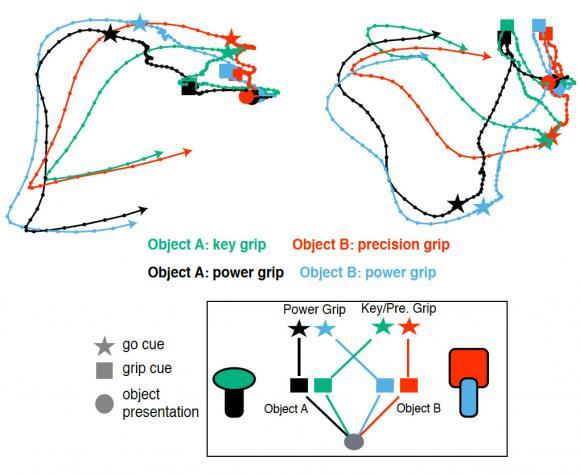
With the results of a new study, neuroscientists have a firmer grasp on the way the brain formulates commands for the hand to grip an object. The advance could lead to improvements in future brain-computer interfaces that provide people with severe paralysis a means to control robotic arms and hands using their thoughts.

The key finding of a research team based at Brown University is that neurons in the area of the brain responsible for planning grasping motions retain information about the object to be gripped as they make their movement plan. The collective neural activity therefore looks different when executing the same grip on one object versus another. This may help the brain design unique patterns when similar actions are performed in different environments.

Wild chimpanzees in the forests of Uganda are increasingly eating clay to supplement the minerals in their diet, according to a long-term study published in PLOS ONE. The paper led by the University of Oxford describes how the researchers observed wild chimpanzees in the Budongo forest eating and drinking from clay pits and termite mounds.

The paper concludes that this change in diet may be partly due to the widespread destruction of raffia palm trees that chimps relied on for their minerals in the past. However, the main reason seems to be the chimps have recently started to boost the minerals in their diet by eating the clay which also helps them 'detox' and digest their food.

Sleeping not only protects memories from being forgotten, it also makes them easier to access, according to new research which suggest that after sleep we are more likely to recall facts which we could not remember while still awake.

In two situations where subjects forgot information over the course of 12 hours of wakefulness, a night's sleep was shown to promote access to memory traces that had initially been too weak to be retrieved.

The research tracked memories for novel, made-up words learned either prior to a night's sleep, or an equivalent period of wakefulness. Subjects were asked to recall words immediately after exposure, and then again after the period of sleep or wakefulness. 

A biomarker found in the blood of alcohol users is significantly higher in binge drinkers than in those who consume alcohol moderately, according to a study by researchers at the University of Illinois at Chicago. The biomarker, called phosphatidylethanol (PEth), could be used to screen young adults for harmful or heavy drinking such as binge drinking.

Having performed extensive research on alcohol and its effects on health throughout her career, Mariann Piano, professor and head of the department of biobehavioral health science in the UIC College of Nursing, knew PEth is a biomarker associated with alcohol consumption, but it had never been measured in young adults.

A new study by researchers at Sanford Burnham Prebys Medical Discovery Institute (SBP), the National Cancer Institute, and the Chulabhorn Research Institute has found that blocking the activity of a key immune receptor, the lymphotoxin-beta receptor (LTβR), reduces the progression of liver cancer. The results, published today in the online edition of Gut, could provide new treatment strategies for the disease, which is the third leading cause of cancer-related deaths worldwide.

Looking at measurements of the vertebrae - the series of small bones that make up the spinal column - in newborn children, investigators at Children's Hospital Los Angeles found that differences between the sexes are present at birth. Results of the study, now online in advance of publication in the August issue of the Journal of Pediatrics, suggest that this difference is evolutionary, allowing the female spine to adapt to the fetal load during pregnancy.

Using magnetic resonance imagining (MRI), the researchers found that vertebral cross-sectional dimensions, a key structural determinant of the vertebra's strength, were 10.6 percent smaller on average in newborn females than in males.