New chemical compounds that can make key modifications to common sugar molecules - glycans - which are found on the surface of all cells in our body are new tools for investigating treatments for chronic inflammation, autoimmune diseases, cancer metastasis and related conditions.
A new study describes compounds that selectively block the attachment to the cell of two types of sugar building blocks, sialic acid and fucose, which are found at the tips of cell surface glycans and can be critical to cell function.
Around 100,000 years ago, human evolution was in a rut, modern human ancestors consisted of 5-10,000 individuals living in Africa.
Yet modern humans somehow emerged from this population bottleneck, expanding dramatically in both number and range, and replacing all other co-existing evolutionary cousins, like Neanderthals. What caused this bottleneck in the first place? Answers range from gene mutations to cultural developments like language to climate-altering events, like a massive volcanic eruption.
Maybe there is another possible factor: infectious disease.
Researchers announced the discovery of Afrasia djijidae, a new early anthropoid fossil.
The 37-million-year-old Afrasia djijidae resembles another early anthropoid, Afrotarsius libycus, recently discovered at a site of similar age in the Sahara Desert of Libya. That close similarity between Afrasia and Afrotarsius indicates that early anthropoids colonized Africa only shortly before the time when these animals lived. The colonization of Africa by early anthropoids was a pivotal step in primate and human evolution, because it set the stage for the later evolution of more advanced apes and humans there.
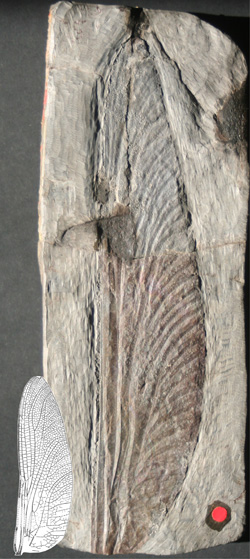
There was a time when giant insects ruled the skies and it corresponded to high oxygen levels.
After the evolution of birds, about 150 million years ago, insects got smaller - despite rising oxygen levels. What gives?
Insects reached their biggest sizes about 300 million years ago during the late Carboniferous and early Permian periods. This was the reign of the predatory griffinflies, giant dragonfly-like insects with wingspans of up to 28 inches - creepy. The leading theory attributed their large size to high oxygen concentrations in the atmosphere (over 30 percent, compared to 21 percent today), which allowed giant insects to get enough oxygen through the tiny breathing tubes that insects use instead of lungs.
Michael Richmond of Rochester Institute of Technology created a simple example for how to determine the astronomical unit - the distance from Earth to the Sun and therefore the basis for all modern measurements in space for the CLEA workshop in 2004, the last time we had a transit of Venus - and it won't happen again in our lifetimes so tomorrow is the last chance to see it.
A new durable, environmentally-benign (we all hope) blue pigment has also been found to have unusual characteristics in reflecting heat - it's much better at it than most blue pigments in use. The compound just received patent approval and was discovered by Oregon State University scientists who were instead studying some materials for their electrical properties.


 Wavelengths Of Light Are Why CO2 Cools The Upper Atmosphere But Warms Earth
 Here's Where Your Backyard Was 300 Million Years Ago
 Convergent Evolution Cheat Sheet Now 120 Million Years Old
 Synchrotron Could Shed Light On Exotic Dark Photons