Feel lazy? Maybe you can blame your genes.
Specially-bred mice which had two genes removed, which control the protein AMP-activated protein kinase (AMPK), an enzyme that is switched on when you exercise, didn't want to run a ny more.
"Mice love to run," said Gregory Steinberg, associate professor of medicine in the Michael G. DeGroote School of Medicine at McMaster University. "While the normal mice could run for miles, those without the genes in their muscle could only run the same distance as down the hall and back. It was remarkable. The mice looked identical to their brothers or sisters but within seconds we knew which ones had the genes and which one didn't."
People communicate in bursts. In communication, our behavior does not happen in a homogenous way over time, but rather there is universal behavior in which there is no communication, followed by short intervals, says a new study.
A new study analyzed around 9,000 million calls throughout a nearly one year period and identified features of the communication process and attempted to quantify their impact in the diffusion of information.
Everyone agrees what the LHC needs is more art.
Okay, no one actually thinks that. What the LHC needs is to find a Higgs boson or a whole bunch of Europeans outside physics are going to be annoyed they spent $10 billion to find the "God particle" and will now be told 'we advanced science by not finding it'. Most people don't think in terms of negatives, they think in terms of positives, so in a bad economy the political questions will be 'why did we spend billions of Euros to confirm the non-existence of something a lot of physicists didn't think existed anyway?'
The Encyclopedia of Life (EOL), a
free, online collaborative tool, is expanded in its second edition released today, offering information on more than one-third of all known species on Earth.
EOLv2 has 20 times as many pages as when the EOL.org first launched in 2008 - 700,000 today. The global partnership of 170 content providers behind EOL.org wants to build a site with 1.9 million pages, one for every species known to science.
Breast-feeding mothers are far more likely to demonstrate a 'mama bear' effect', aggressively protecting their infants and themselves , than women who bottle-feed their babies or who are non-mothers, says a new study in Psychological Science.
To help mama bear out, breast-feeding mothers register lower blood pressure than other women when behaving aggressively - the researchers say suggests breast-feeding helps dampen the body’s stress response to fear; breast-feeding mothers are more likely to be courageous.
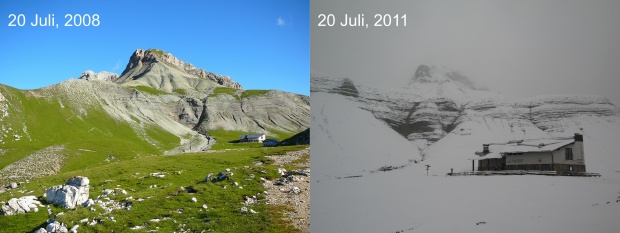
Mountains sure aren´t what they used to be. Take the Dolomites in the Veneto Region of Italy and Austria; 140 to 90 million years ago, they were part of the sea floor rather than mountains.
Over millions of years, deposits were then formed from calcareous shells of marine life from the Mesozoic era. Tectonic forces later caused these sediments to rise upward to the mountaintops of today´s well-known and popular Southern Alps. The mountain range contains one of the most complete and most accessible geological records - also being one of the richest in fossils - from the Cretaceous period in Europe. This record was scientifically analyzed in-depth for the first time within the framework of a project supported by the Austrian Science Fund FWF.


 Ousiometrics Analysis Says All Human Language Is Biased
  Wavelengths Of Light Are Why CO2 Cools The Upper Atmosphere But Warms Earth
 Here's Where Your Backyard Was 300 Million Years Ago
 Convergent Evolution Cheat Sheet Now 120 Million Years Old