Banner
Ousiometrics Analysis Says All Human Language Is Biased

A new tool drawing on billions of uses of more than 20,000 words and diverse real-world texts claims...

Wavelengths Of Light Are Why CO2 Cools The Upper Atmosphere But Warms Earth

There are concerns about projected warming on the Earth’s surface and in the lower atmosphere...

Here's Where Your Backyard Was 300 Million Years Ago

We may use terms like "grounded" and terra firma to mean stability and consistency but geology...

Convergent Evolution Cheat Sheet Now 120 Million Years Old

One tenet of natural selection is a random walk of genes but nature may be more predictable than...

User picture.
News StaffRSS Feed of this column.

News Releases From All Over The World, Right To You... Read More »

Blogroll
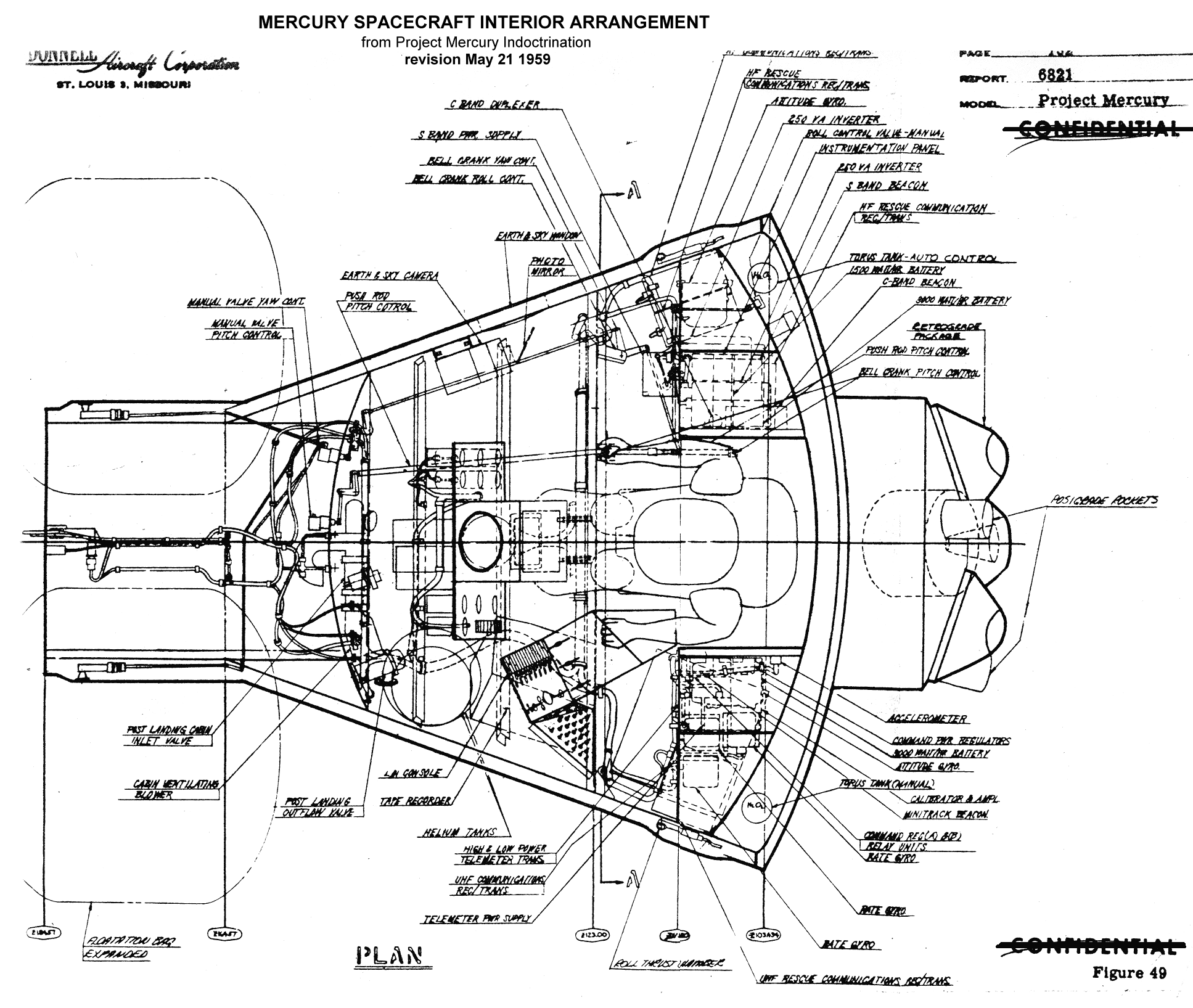
50 years ago today Alan Shepard became the first American into space, launching at just after 9AM from the Space Coast of Florida and finishing just over 15 minutes and 117 miles up later. 

The most famous book (and movie) about the early days of NASA is "The Right Stuff" and it is surprisingly faithful in its telling.   Alan Shepard did pee in his suit and then say, after three hours of being immobilized in a tiny capsule, "Why don't you just fix your little problem and light this candle?"   but he was also a guy who said, "You know, being a test pilot isn't always the healthiest business in the world" so he understood the risks.   96% chance of survival was acceptable risk.
Over 100 million years ago, late Mesozoic forests were chock full of a diverse group of plants of the class Equisetopsida, though only one genus, Equisetum, commonly called scouring rush or horsetail, still exists today.  

It is unclear about the evolutionary beginnings of the genus Equisetum - molecular dating places the divergence of the 15 extant species of the genus around 65 million years ago but the fossil record had it earlier than that, around 136 million years ago.
A community survey in England identified people with autism or asperger's syndrome  and found none of them knew they have it.    And autism turned out to be more prevalent in males with lower education and in government housing.

Is autism causing people to have lower education and jobs or has the umbrella gotten so large it has become a blanket diagnosis for everyone not successful?

The results from the first ever general population survey of autism in adulthood. They are based on a two phase epidemiological survey in England (7,461 screening interviews; 618 diagnostic) carried out in 2007. The findings are in the Archives of General Psychiatry.
Rice, the eponymous food of Asia, originated in China, and domesticated rice may have first appeared as far back as approximately 9,000 years ago in the Yangtze Valley of China. Previous research suggested domesticated rice may have two points of origin, India as well as China.

The genome researchers used large-scale gene re-sequencing to re-assess the phylogeny, or evolutionary history, of domesticated rice using previously published datasets, some of which have been used to argue that indica and japonica rice have separate origins. Using newer computer algorithms, however, the researchers concluded these two species have the same origin because they have a closer genetic relationship to each other than to any wild rice species found in either India or China.
Acetaminophen overdose has become the leading cause of acute liver failure in the U.S.  How is that possible, when ingredients are printed clearly on the labels, along with warnings?  

Acetaminophen's is in more than 600 over-the-counter and prescription medicines and people take billions of doses of over-the-counter pain relievers every year, but many do not pay attention to the active ingredients they contain, such as acetaminophen, according to a new Northwestern Medicine study. 
The first observatory experiment to study the dynamic microbial life inside Earth's crust has just been completed.  During the four-year subsurface experiment, the research team deployed the first in situ experimental microbial observatory systems below the flank of the Juan de Fuca Ridge, which is located off the coast of Washington (U.S.) and British Columbia (Canada).