In early times, a raven could be a bad omen, and a new study finds that ancient people were not wrong in thinking the raven might be planning on using a negative event to full advantage. It turns out, according to the paper, they plan ahead, just like humans, and can even forgo an immediate reward in order to gain a better one in the future, which at least some humans do. Great apes too.
Ravens and great apes have not shared a common ancestor for over 300 million years, so what explains it? Evolution is not a straight line and the authors speculate that the cognitive "planning" abilities they share in common re-appeared, on a separate evolutionary path, in the birds.
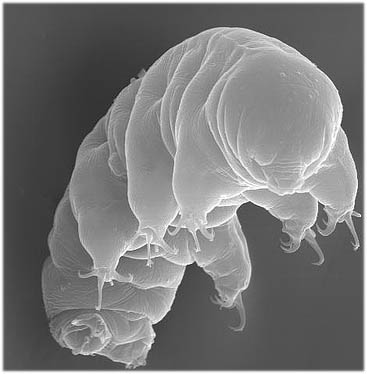
It won't matter if all the ice melts and seas rise 100 feet, even if frogs rain from the skies and dogs and cats are living together, one species will be around until the sun explodes.
That species is the eight-legged micro-animal tardigrade, the world's most indestructible species.
Men who worry that women may not make the right decisions during a menstrual cycle, and women who claim biology is a valid excuse for being a jerk, you're both out of luck.
An examination of three aspects of cognition across two menstrual cycles found that the levels of estrogen, progesterone and testosterone had no impact on working memory, cognitive bias or ability to pay attention to two things at once.
While some hormones were associated with changes across one cycle in some of the women taking part, these effects didn't repeat in the following cycle. Overall, none of the hormones the team studied had any replicable, consistent effect on study participants' cognition.
A theory is a very precise thing in science - yet some scientists can't resist using the term to lend intellectual weight to what may be a hypothesis and is likely just reasonable speculation. It's a large part of the reason why the term has become colloquialized, and 'wellness' is equivalent to gravity in the minds of some.
Physical science is not immune. String Theory put theory in the name, so it gets to skate on the edges of truth, but theoretical physicists are trying to recapture the Golden Age of the 1930s, plus write a bestselling book. Astrophysics should know better. Yet many have still used the word theory to describe the "glitch" and "wobble" detected among pulsars, despite having no basis for it.
It's been shown that there is no hiring deficit for women in science; women have been hired far more than men for new jobs. Yet women's groups have continued to point to total numbers as the problem, as if to say older men who have been supportive of more diversity and are making it happen on hiring committees should be fired without cause to open up more jobs for women.
Only the weakest candidate wants to be hired as part of a quota. There has to be a better way.
Use of performance enhancing drugs is a major problem in many competitive sports and the 2017 prohibited list includes over 300 substances. However, the scientific evidence around these substances is scarce, partly because it is impossible to do trials with professional cyclists who are subject to anti-doping regulation.
Meanwhile, media attention given to performance enhancing drugs may encourage amateurs to try them. But it is unlikely to help, according to a new paper published in The Lancet Haematology journal.


 Pilot Study: Fibromyalgia Fatigue Improved By TENS Therapy
 High Meat Consumption Linked To Lower Dementia Risk
 Long Before The Inca Colonized Peru, Natives Had A Thriving Trade Network
 Mesolithic People Had Meals With More Tradition Than You Thought