Banner
Here's Where Your Backyard Was 300 Million Years Ago

We may use terms like "grounded" and terra firma to mean stability and consistency but geology...

Convergent Evolution Cheat Sheet Now 120 Million Years Old

One tenet of natural selection is a random walk of genes but nature may be more predictable than...

Synchrotron Could Shed Light On Exotic Dark Photons

There are many hypothetical particles proposed to explain dark matter and one idea to explore how...

The Pain Scale Is Broken But This May Fix It

Chronic pain is reported by over 20 percent of the global population but there is no scientific...

User picture.
News StaffRSS Feed of this column.

News Releases From All Over The World, Right To You... Read More »

Blogroll
Monkeys playing a game similar to "Let's Make A Deal" have revealed that their brains register missed opportunities and learn from their mistakes. 

The researchers watched individual neurons in a region of the brain called the anterior cingulate cortex (ACC) that monitors the consequences of actions and mediates resulting changes in behavior. The monkeys were making choices that resulted in different amounts of juice as a reward. 

Their task was like the TV show "Let's Make a Deal" with the experimenters offering monkeys choices from an array of hidden rewards. During each trial, the monkeys chose from one of eight identical white squares arranged in a circle. A color beneath the white square was revealed and the monkey received the corresponding reward. 
To study small RNA, snippets of RNA that act as switches to regulate gene expression in single-celled creatures, you need lab-cultured microorganisms but a new method of obtaining marine microbe samples while preserving the microbes' natural gene expression has shown the presence of many varieties of small RNAs.  

The discovery of its presence in a natural setting may make it possible finally to learn on a broad scale how microbial communities living at different ocean depths and regions respond to environmental stimuli.
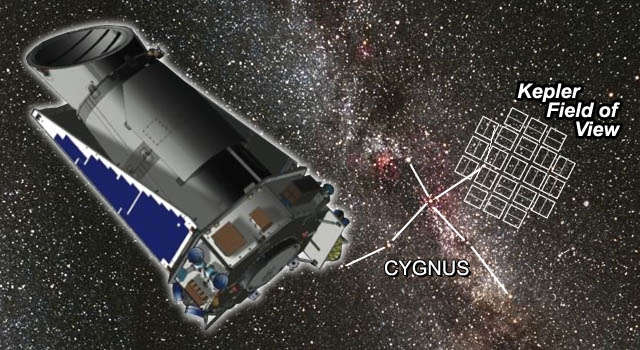
NASA's Kepler spacecraft has begun its search for other Earth-like worlds. The mission, which launched from Cape Canaveral, Fla., on March 6, will spend the next three-and-a-half years staring at more than 100,000 stars for telltale signs of planets. Kepler has the unique ability to find planets as small as Earth that orbit sun-like stars at distances where temperatures are right for possible lakes and oceans. 
A bowl of whole-grain cereal is as good as a sports drink for recovery after exercise. Research published in BioMed Central’s open access Journal of the International Society of Sports Nutrition has shown that the readily available and relatively inexpensive breakfast food is as effective as popular, carbohydrate-based ‘sports drinks’.
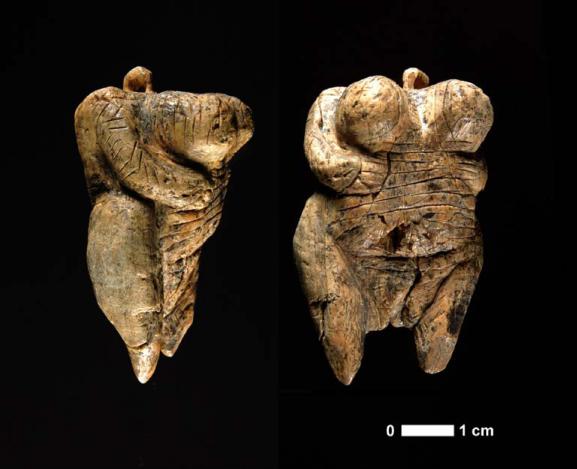
2008 excavations at Hohle Fels Cave in the Swabian Jura of southwestern Germany recovered a female figurine carved from mammoth ivory from the basal Aurignacian deposit. The figurine is the earliest depiction of a human and one of the oldest known examples of figurative art worldwide and is at least 35,000 years old.

If you're looking closely at the Venus of Hohle Fels below, you may also notice those are breasts, which radically changes our views of the context and meaning of the earliest Paleolithic art; maybe it's porn-eolithic.

Venus of Hohle Fels Swabian Jura
A new report published in Cell says that a heart beat and blood circulation are critical signals for the production of blood-forming, or hematopoietic, stem cells in the developing embryo.