Banner
Here's Where Your Backyard Was 300 Million Years Ago

We may use terms like "grounded" and terra firma to mean stability and consistency but geology...

Convergent Evolution Cheat Sheet Now 120 Million Years Old

One tenet of natural selection is a random walk of genes but nature may be more predictable than...

Synchrotron Could Shed Light On Exotic Dark Photons

There are many hypothetical particles proposed to explain dark matter and one idea to explore how...

The Pain Scale Is Broken But This May Fix It

Chronic pain is reported by over 20 percent of the global population but there is no scientific...

User picture.
News StaffRSS Feed of this column.

News Releases From All Over The World, Right To You... Read More »

Blogroll
A new way to reduce carbon dioxide emissions and tackle climate change had been unveiled by a group of  economists.   Or an old way, depending on how long you have been around.   Under their proposals, companies would buy what are in effect permits to pollute, but the price of those permits would be controlled because the government would retain enough, at a fixed price, to stop the cost increasing above that level. 

Yes, it is price controls all over again.  Welcome to 1972.
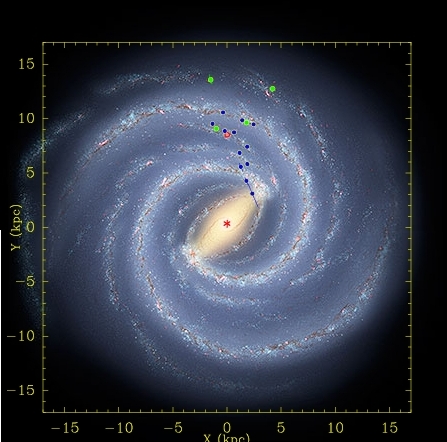
Let's face it, with all that talk about life on other planets and dark matter, we lose sight of the big picture.  To start 2009 off right, the Milky Way, our galaxy, wants you to know she is not out of coolness yet.  To wit, new measurements of the Milky Way say our home Galaxy is rotating about 100,000 miles per hour faster than previously thought.
Physicists at Indiana University have developed a promising new way to identify a possible abnormality in a fundamental building block of Einstein's theory of relativity known as "Lorentz invariance." If confirmed, the abnormality would disprove the basic tenet that the laws of physics remain the same for any two objects traveling at a constant speed or rotated relative to one another.

IU distinguished physics professor Alan Kostelecky and graduate student Jay Tasson take on the long-held notion of the exact symmetry promulgated in Einstein's 1905 theory and show in a paper to be published in the Jan. 9 issue of Physical Review Letters that there may be unexpected violations of Lorentz invariance that can be detected in specialized experiments.
Women with bulimia nervosa appear to respond more impulsively during psychological testing than those without eating disorders, and brain scans show differences in areas responsible for regulating behavior, according to a report in the January issue of Archives of General Psychiatry.
Commonly used pneumococcal polysaccharide vaccines do not appear to be effective for preventing pneumonia, found a study by a team of researchers from Switzerland and the United Kingdom writing in the Canadian Medical Association Journal.

In many industrialized countries, polysaccharide pneumococcal vaccines (PPVs) are currently recommended to help prevent pneumococcal disease in people aged 65 and over and for younger people with increased risk due to conditions like HIV. Studies have shown conflicting results regarding the efficacy of PPV. 
Astronomers have turned to an unexpected place to study the evolution of planets -- dead stars. 

Observations made with NASA's Spitzer Space Telescope reveal six dead "white dwarf" stars littered with the remains of shredded asteroids. This might sound pretty bleak, but it turns out the chewed-up asteroids are teaching astronomers about the building materials of planets around other stars. 

So far, the results suggest that the same materials that make up Earth and our solar system's other rocky bodies could be common in the universe. If the materials are common, then rocky planets could be, too.