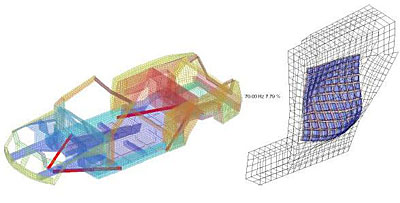
During launch into orbit, a satellite is exposed to a number of extreme stresses. At takeoff the extremely strong engine vibrations are transmitted via the launcher structure to the satellite, which is also exposed to a high-intensity sound levels (140 dB and more). The increasing speed of the of the rocket also leads to aerodynamic strains that turn into a shockwave when the launch vehicle's velocity jumps from subsonic to supersonic.
That's not all. When the burned out rocket stages are blasted off and the next stage is fired up, the satellite is exposed to temporary impulsive vibrations. So how does the satellite survive earthquake-like vibrations, the forces of supersonic shock waves and the pressures of explosive blasts?
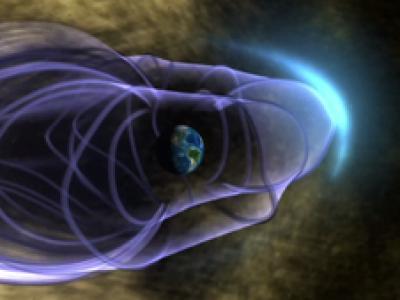
Earth's magnetic field, which shields our planet from particles streaming outward from the Sun, often develops two holes that allow the largest leaks, according to researchers sponsored by NASA and the National Science Foundation.
"The discovery overturns a long-standing belief about how and when most of the solar particles penetrate Earth's magnetic field, and could be used to predict when solar storms will be severe. Based on these results, we expect more severe storms during the upcoming solar cycle," said Vassilis Angelopoulos of the University of California, Los Angeles, Principal Investigator for NASA's THEMIS mission (Time History of Events and Macroscale Interactions during Substorms). THEMIS was used to discover the size of the leak.
Rocky Mountain ski areas face dramatic changes this century as the climate warms, says a new Colorado study.
The study indicates snowlines -- elevations below which seasonal snowpack will not develop -- will continue to rise through this century, moving up more than 2,400 feet from the base areas of Colorado's Aspen Mountain and Utah's Park City Mountain by 2100, said University of Colorado at Boulder geography Professor Mark Williams. Williams and Brian Lazar of Stratus Consulting Inc. of Boulder combined temperature and precipitation data for Aspen Mountain and Park City Mountain with general climate circulation models for the study.
Schizophrenia and autism probably share a common origin, according to Dutch researcher Annemie Ploeger following an extensive literature study. The developmental psychologist says that both mental diseases have similar physical abnormalities which are formed during the first month of pregnancy.
Since the early 1960s, it's become fashionable to use scare tactics about food and food groups to generate publicity and generate fundraising dollars. The DDT mistake is forgivable but
Alar? Pure money-driven hysteria.
Neuroscientists from Duke University Medical Center have discovered that older people use their brains differently than younger people when it comes to storing memories, particularly those associated with negative emotions.
The study, appearing in Psychological Science, is a novel look at how brain connections change with age.


 Here's Where Your Backyard Was 300 Million Years Ago
 Convergent Evolution Cheat Sheet Now 120 Million Years Old
 Synchrotron Could Shed Light On Exotic Dark Photons
 The Pain Scale Is Broken But This May Fix It