Banner
Here's Where Your Backyard Was 300 Million Years Ago

We may use terms like "grounded" and terra firma to mean stability and consistency but geology...

Convergent Evolution Cheat Sheet Now 120 Million Years Old

One tenet of natural selection is a random walk of genes but nature may be more predictable than...

Synchrotron Could Shed Light On Exotic Dark Photons

There are many hypothetical particles proposed to explain dark matter and one idea to explore how...

The Pain Scale Is Broken But This May Fix It

Chronic pain is reported by over 20 percent of the global population but there is no scientific...

User picture.
News StaffRSS Feed of this column.

News Releases From All Over The World, Right To You... Read More »

Blogroll
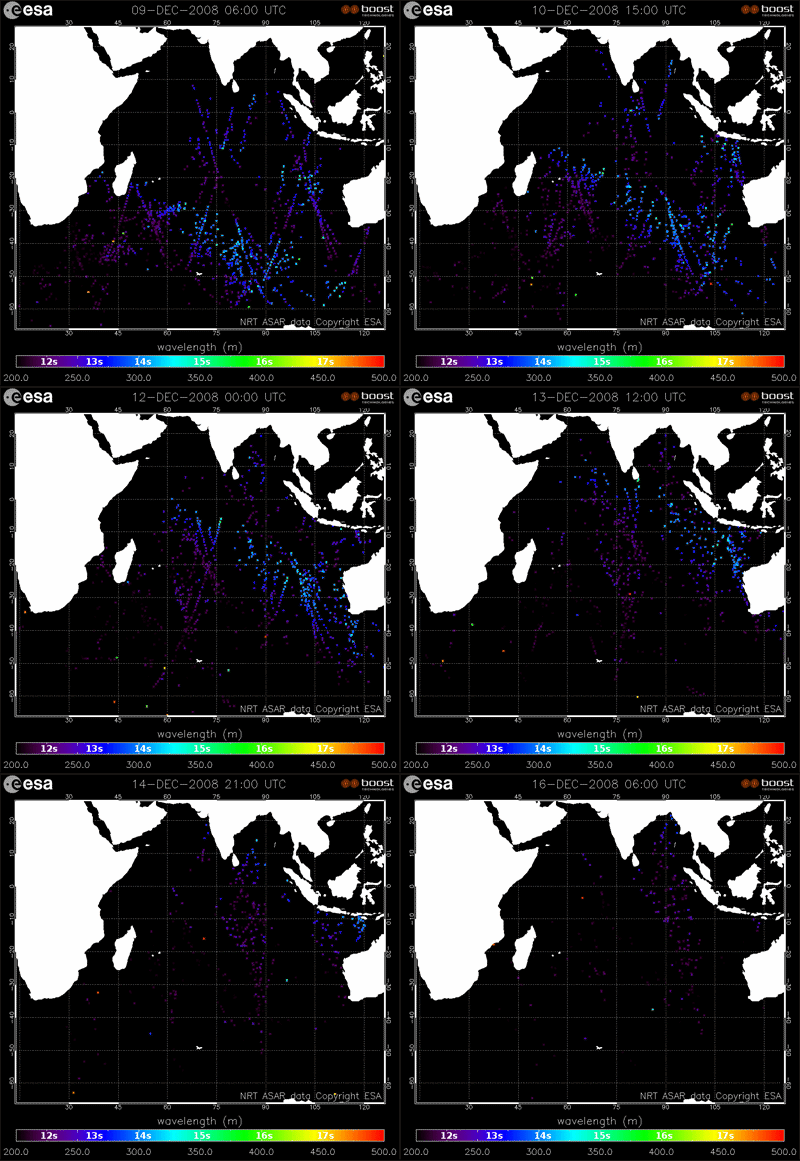
CLS, a subsidiary of the French Space Agency (CNES), acting through its new radar applications division (formerly the BOOST Technologies Company), wants you to know they can use Envisat radar imagery to operationally observe oceans at high resolution so they're observing meteorological conditions in the track of the Vendee Globe solo round-the-world yacht race. 

Based on the trajectory and speed of the boats, CLS is acquiring data over the area skippers will be sailing into slightly ahead of their arrival time in order to monitor the metocean conditions.  
Researchers have figured out why a respiratory syncytial virus vaccine used in 1966 to inoculate children against the infection instead caused severe respiratory disease and effectively stopped efforts to make a better one. The findings in Nature Medicine could restart work on effective killed-virus vaccines not only for RSV but other respiratory viruses, researchers say. They also say the new findings debunk a popular theory that the 1966 vaccine was ineffective because the formalin used to inactivate the virus disrupted critical antigens, the substances that stimulate the production of protective antibodies.
A dose of the hormone Oxytocin reduces the stress hormone Cortisol in arguing couples. In addition, Oxytocin strengthens positive behaviour, as researchers at the University of Zurich have discovered.

Various studies in recent years have shown that the hormone Oxytocin in the brain of mammals can help in regulating social behavior. Beate Ditzen from the Psychological Institute of the UZH has now, together with colleagues from the University of Zurich, examined the hormone particularly in terms of the behavior in partnerships. 
Learning a feeling of safety activates cellular and molecular processes that act against depression. This has been analysed using a new animal model that helps examine and explain the relevant cell biology processes more effectively. The findings now published in the journal Neuron show that "learned safety" can have an anti-depressive effect comparable to pharmacological antidepressants but that this effect is controlled by other molecular processes. 
It's a bad thing in sports, but a goose egg in a warming Arctic could be a good thing - for polar bears.   New calculations show that changes in the timing of sea-ice breakup and of snow goose nesting near the western Hudson Bay could provide at least some polar bears with this alternative source of food. This new analysis appears in Polar Biology.
As ice melts away from Antarctica, parts of the continental bedrock are rising in response -- and other parts are sinking, scientists have discovered, and the finding will give much needed perspective to satellite instruments that measure ice loss on the continent, and help improve estimates of future sea level rise.

"Our preliminary results show that we can dramatically improve our estimates of whether Antarctica is gaining or losing ice," said Terry Wilson, associate professor of earth sciences at Ohio State University.  Wilson reported the research in a press conference Monday, December 15, 2008 at the American Geophysical Union meeting in San Francisco.    These results come from a trio of global positioning system (GPS) sensor networks on the continent.