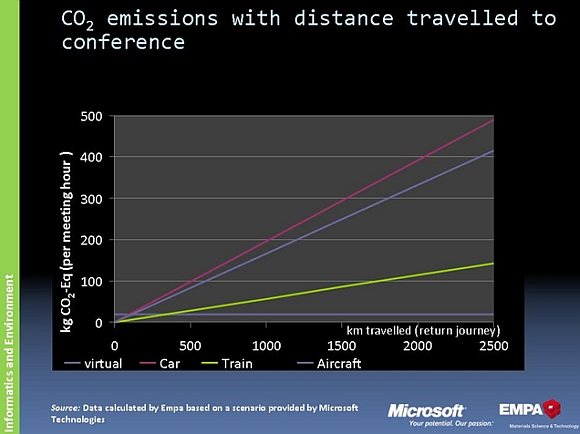
Does your boss feel like an environmentally aware entrepreneur? If so, it might be worth mentioning that business travel, conferences and meetings have an effect on the environment. Virtual participation is possible but computers, networks and the entire data infastructure consume massive amounts of power as well.
What is needed is a way to quantify meetings in terms of energy use. At a recent “Informatics Day at the Technopark Zurich" , a Microsoft booth allowed visitors were able to test how much CO2 they would save, if any, if they replaced a “real” meeting with a videoconference. Using life cycle analysis methods and the «ecoinvent» database, Empa researchers produced comparative data showing what environmental effects were created, and where.
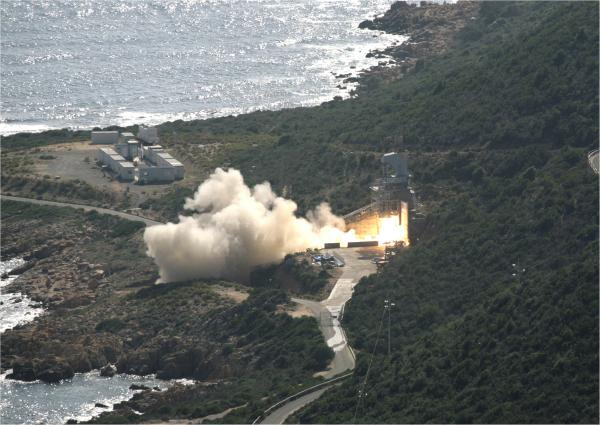
Yesterday, the Zefiro 9-A motor successfully completed its first firing test at the Salto di Quirra Inter-force Test Range in Sardinia (Italy). This was the penultimate firing test for the engine prior to the Vega launcher’s qualification flight, scheduled to take place by the end of 2009.
The Zefiro 9-A (Z9-A) solid-fuel rocket motor, which will power the Vega launch vehicle’s third stage, left the production facility of Avio, in Colleferro (Italy), at the end of September and was installed at the test site over the last three weeks.
Does ice-cream actually taste better when it is licked from a cone than when eaten from a spoon?
Massey food technology senior lecturer Kay McMath thinks so. Although she is not aware of any specific scientific evidence to prove it, she says “there are some physical and physiological reasons why there are likely to be differences in flavour”.
“Flavour in ice cream is only released when the fat content – which carries the flavour – is warmed in the mouth to at least body temperature,” she says.
“During licking, the tongue is coated with a thin layer of ice-cream which is more quickly warmed and the flavour is detected by the large surface area of the taste buds present on the tongue.”
Some animals live longer when raised on low-calorie diets but now researchers at Washington University School of Medicine in St. Louis say that they can extend the life spans of roundworms even when the worms are well fed — it just takes a chemical that blocks their sense of smell.
Three years ago, the researchers, led by Kerry Kornfeld, M.D., Ph.D., reported they found that a class of anticonvulsant medications made the roundworm Caenorhabditis elegans live longer. But until now, they didn't quite know what the drugs did to give the worms their longevity.
The dense, hot, radioactive core of the Sun rotates significantly more slowly than the layer next to it, the radiative zone, a Stanford solar physicist has concluded. According to Peter Sturrock, professor emeritus of applied physics, the idea of a slower core has been hinted at before, but his paper published in the Astrophysical Journal provides for the first time a precise rotation rate.
- The core spins round once every 28.4 days
- The radiative zone rotates once every 26.9 days
- The surface rotates faster still-once every 25.2 days.
Sneezing, runny nose and chills? You might blame the human rhinovirus (HRV), which causes 30 to 50 percent of common colds. But in reality, it's not the virus itself but HRV's ability to manipulate your genes that is the true cause of some of the most annoying cold symptoms.
For the first time, researchers have shown that HRV hijacks many of your genes and causes an overblown immune response that ends up with your nose being overblown.
The research, published in the first issue for November of the American Thoracic Society's clinical research journal, the American Journal of Respiratory and Critical Care Medicine, is the first study to comprehensively review gene changes caused by HRV.


 Synchrotron Could Shed Light On Exotic Dark Photons
 The Pain Scale Is Broken But This May Fix It
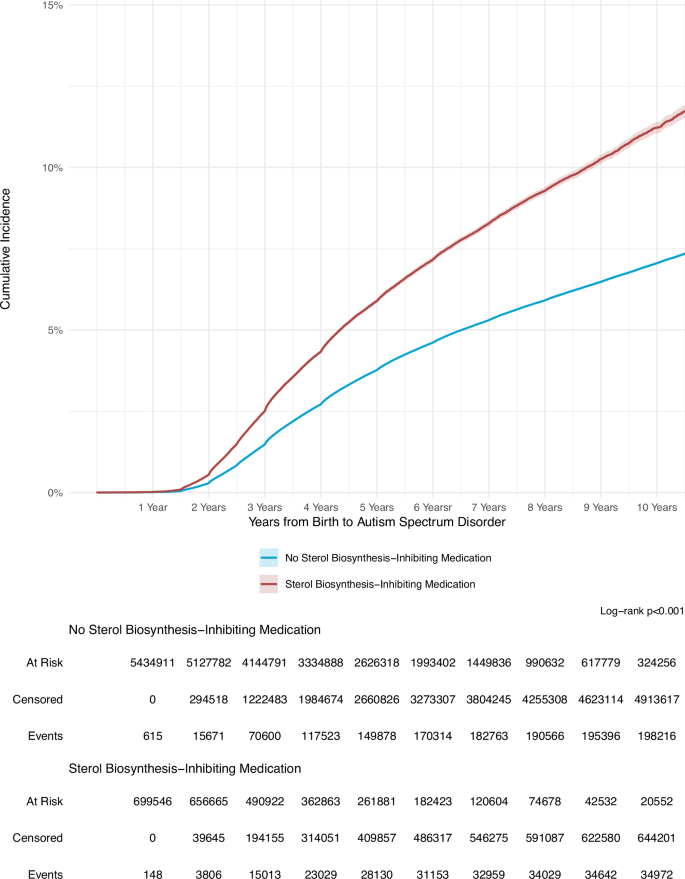 Study Links Antidepressants, Beta-blockers and Statins To Increased Autism Risk
 Pilot Study: Fibromyalgia Fatigue Improved By TENS Therapy