Banner
Synchrotron Could Shed Light On Exotic Dark Photons

There are many hypothetical particles proposed to explain dark matter and one idea to explore how...

The Pain Scale Is Broken But This May Fix It

Chronic pain is reported by over 20 percent of the global population but there is no scientific...
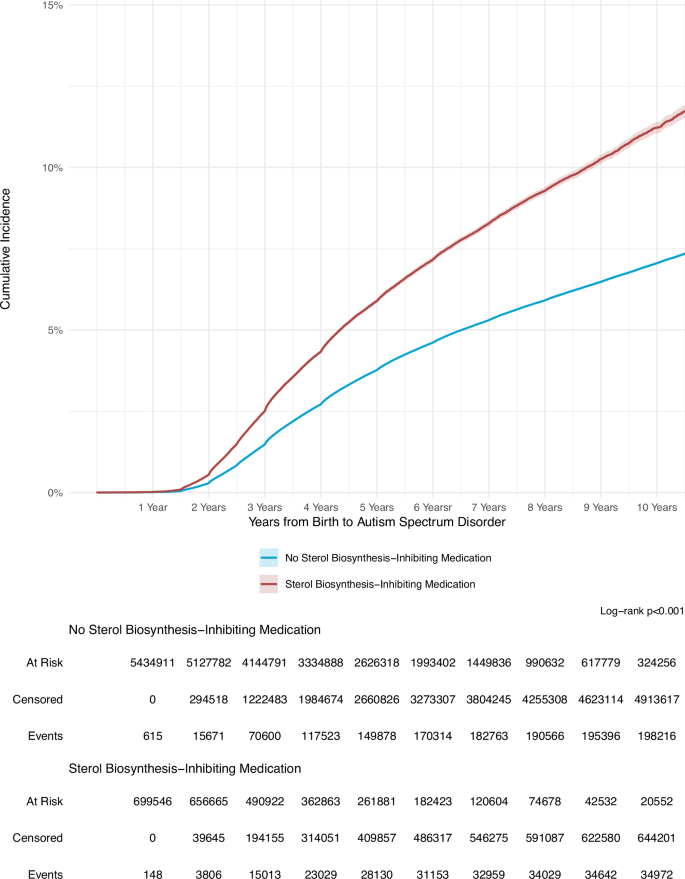
Study Links Antidepressants, Beta-blockers and Statins To Increased Autism Risk

An analysis of 6.14 million maternal-child health records  has linked prescription medications...

Pilot Study: Fibromyalgia Fatigue Improved By TENS Therapy

Fibromyalgia is the term for a poorly-understood condition where people experience pain and fatigue...

User picture.
News StaffRSS Feed of this column.

News Releases From All Over The World, Right To You... Read More »

Blogroll

Scientists at the University of Leicester, where genetic 'fingerprinting' was invented by Professor Sir Alec Jeffreys, say they are developing techniques which may one day allow police to work out someone’s surname from DNA alone.

Research by Turi King has shown that, unsurprisingly, men with the same British surname are highly likely to be genetically linked even in today's multicultural world. The results of her research have implications in the fields of forensics, genealogy, epidemiology and the history of surnames.

On Wednesday 8th October Dr King will present the key findings of her Ph.D. research in which she recruited over two and a half thousand men bearing over 500 different surnames to take part in the study. Carried out in Professor Mark Jobling’s lab, Dr Turi King’s research involved exploring this potential link between surname and Y chromosome type.

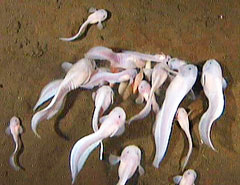
Scientists filming in one of the world’s deepest ocean trenches have found groups of highly sociable snailfish swarming over their bait, nearly five miles (7700 metres) beneath the surface of the Pacific Ocean. This is the first time cameras have been sent to this depth.

‘We got some absolutely amazing footage from 7700 metres. More fish than we or anyone in the world would ever have thought possible at these depths,’ says project leader Dr Alan Jamieson of the University of Aberdeen’s Oceanlab, on board the Japanese research ship the Hakuho-Maru.

‘It’s incredible. These videos vastly exceed all our expectations from this research. We thought the deepest fishes would be motionless, solitary, fragile individuals eking out an existence in a food-sparse environment,’ says Professor Monty Priede, director of Oceanlab.

Smell plays an important role in our lives: It influences the way in which we choose fruit and vegetables, perfume, and even a partner. And yet, smell is not just what we smell with our noses, it's also what we taste, explains Prof. Alexander Vainstein, who is heading the team at the Robert H. Smith Faculty of Agriculture, Food and Environment at the Hebrew University of Jerusalem. "Aroma is of major importance for defining the taste of food."

Scent in flowers and plants is used to attract pollinating insects like bees and beetles that pass on the pollen and help in the reproduction and creation of fruit. The intensity of the scent that the flower emanates is influenced by the time of day, depending on weather, age of the flower and the species.

Now Vainstein and others have found a way to genetically enhance the scent of flowers and implant a scent in those that don't have one.

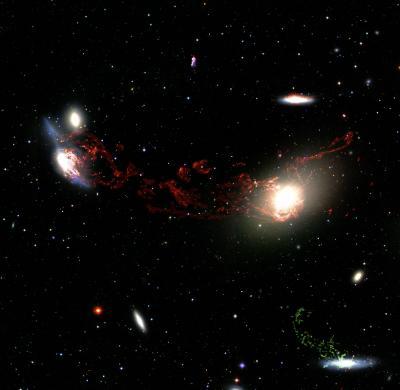
Astronomers studying new images of a nearby galaxy cluster have found evidence that high-speed collisions between large elliptical galaxies may prevent new stars from forming, according to a paper in the November 2008 Astrophysical Journal Letters.

Led by Jeffrey Kenney, professor and chair of astronomy at Yale, the team saw a spectacular complex of warm gas filaments 400,000 light-years-long connecting the elliptical galaxy M86 and the spiral galaxy NGC 4438 in the Virgo galaxy cluster, providing striking evidence for a previously unsuspected high-speed collision between the galaxies. The view was constructed using the wide-field Mosaic imager on the National Science Foundation telescope at Kitt Peak National Observatory near Tucson, Arizona.

Moderate consumption of red wine may decrease the risk of lung cancer in men, according to a report in the October issue of Cancer Epidemiology, Biomarkers & Prevention.

Chun Chao, Ph.D., a research scientist at Kaiser Permanente Department of Research and Evaluation in Pasadena, California, analyzed data collected through the California Men's Health Study, which linked clinical data from California's health system with self-reported data from 84,170 men aged 45 to 69 years. Researchers obtained demographics and lifestyle data from surveys computed between 2000 and 2003, and identified 210 cases of lung cancer.

The Royal Swedish Academy of Sciences has decided to award the Nobel Prize in Physics for 2008 with one half to Yoichiro Nambu of the Enrico Fermi Institute, University of Chicago, IL, USA "for the discovery of the mechanism of spontaneous broken symmetry in subatomic physics"

and the other half jointly to;

Makoto Kobayashi, High Energy Accelerator Research Organization (KEK), Tsukuba, Japan and Toshihide Maskawa,Yukawa Institute for Theoretical Physics (YITP), Kyoto University, Japan, "for the discovery of the origin of the broken symmetry which predicts the existence of at least three families of quarks in nature".