Banner
Pilot Study: Fibromyalgia Fatigue Improved By TENS Therapy

Fibromyalgia is the term for a poorly-understood condition where people experience pain and fatigue...

High Meat Consumption Linked To Lower Dementia Risk

Older people who eat large amounts of meat have a lower risk of dementia and cognitive decline...

Long Before The Inca Colonized Peru, Natives Had A Thriving Trade Network

A new DNA analysis reveals that long before the Incan Empire took over Peru, animals were...

Mesolithic People Had Meals With More Tradition Than You Thought

The common imagery of prehistoric people is either rooting through dirt for grubs and picking berries...

User picture.
News StaffRSS Feed of this column.

News Releases From All Over The World, Right To You... Read More »

Blogroll

People on polar expeditions can undergo serious negative psychological changes as they struggle to adapt to their isolated, extreme and confined environment; but also positive changes due to sense of achievement after having coped with such a stressful situation.

Dr Lawrence Palinkas, University of Southern California, Los Angeles, USA and Dr Peter Suedfeld, University of British Columbia, Vancouver, did a review of published data on polar expeditions, specifically focussing on psychological or social dimensions of behaviour.

The authors say: “Polar expeditions include treks and stays at summer camps or year-around research stations.

Researchers at UT Southwestern Medical Center have determined how a substance derived from the bark of the South American lapacho tree kills certain kinds of cancer cells, findings that also suggest a novel treatment for the most common type of lung cancer.

The compound, called beta-lapachone, has shown promising anti-cancer properties and is currently being used in a clinical trial to examine its effectiveness against pancreatic cancer in humans. Until now, however, researchers didn’t know the mechanism of how the compound killed cancer cells.

For more than 100 years, scientists have known that humans carry a rich ecosystem within their intestines. An astonishing number and variety of microbes, including as many as 400 species of bacteria, help humans digest food, mitigate disease, regulate fat storage, and even promote the formation of blood vessels.

By applying sophisticated genetic analysis to samples of a year’s worth baby poop, Howard Hughes Medical Institute researchers have now developed a detailed picture of how these bacteria come and go in the intestinal tract during a child’s first year of life.

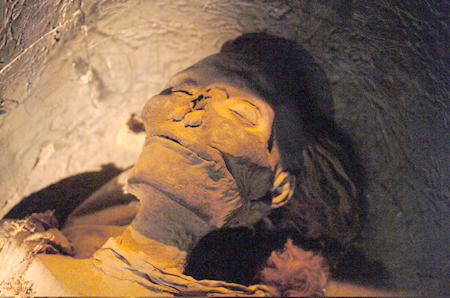
Dr. Zahi Hawass, Secretary General of the Supreme Council of Antiquities in Egypt, sent out this announcement:

On Wednesday (27/6/2007) at 11:00 a.m Culture Minster Farouk Housni and Dr. Zahi Hawass Secretary General of the Supreme Council of Antiquities (SCA) will hold an International Conference at the Egyptian Museum in Tarir in Room 43 to announce the Identification of Hatshepsut's mummy .

Please come to attend the event at 10:00 am. at the Egyptian Museum in order to fix cameras and TV crews.

This is being called the most important discovery in the Valley of the Kings since King Tutankhamun.

Researchers at the University of Pennsylvania have demonstrated that gene therapy used to restore retinal activity to the blind also restores function to the brain’s visual center, a critical component of seeing.

The multi-institutional study led by Geoffrey K. Aguirre, assistant professor of neurology in Penn's School of Medicine, shows that gene therapy can improve retinal, visual-pathway and visual-cortex responses in animals born blind and has the potential to do the same in humans.

“The retina of the eye captures light, but the brain is where vision is experienced,” Aguirre said. “The traditional view is that blindness in infancy permanently alters the structure and function of the brain, leaving it unable to process visual information if sight is restored.

Researchers at the Picower Institute for Learning and Memory at MIT have, for the first time, reversed symptoms of mental retardation and autism in mice.

The mice were genetically manipulated to model Fragile X Syndrome (FXS), the leading inherited cause of mental retardation and the most common genetic cause of autism. The condition, tied to a mutated X chromosome gene called fragile X mental retardation 1 (FMR1) gene, causes mild learning disabilities to severe autism.

According to the Centers for Disease Control, FXS affects one in 4,000 males and one in 6,000 females of all races and ethnic groups. The prevalence of autism ranges from one in 500 to one in 166 children. There is no effective treatment for FXS and other types of autism.