Banner
Pilot Study: Fibromyalgia Fatigue Improved By TENS Therapy

Fibromyalgia is the term for a poorly-understood condition where people experience pain and fatigue...

High Meat Consumption Linked To Lower Dementia Risk

Older people who eat large amounts of meat have a lower risk of dementia and cognitive decline...

Long Before The Inca Colonized Peru, Natives Had A Thriving Trade Network

A new DNA analysis reveals that long before the Incan Empire took over Peru, animals were...

Mesolithic People Had Meals With More Tradition Than You Thought

The common imagery of prehistoric people is either rooting through dirt for grubs and picking berries...

User picture.
News StaffRSS Feed of this column.

News Releases From All Over The World, Right To You... Read More »

Blogroll

Buckyballs, or fullerenes, are nanoparticles containing 60 carbon atoms.

Bacteria called Dehalococcoides Ethenogenes, discovered in Ithaca sewage sludge in 1997 by James Gossett, Cornell professor of civil and environmental engineering, are now in wide use to detoxify some carcinogenic chemicals but they could be used for a lot more.

These bacteria remove chlorine atoms from molecules and leave less-toxic compounds behind in toxic waste like perchloroethylene (PCE) and trichloroethylene (TCE).

But D. ethenogenes strains work well at some sites and not so well at others, and nobody knows why.


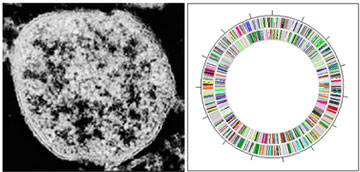
The bacterium Dehalococcoides ethogenes can extract chlorine from chemicals to help clean up toxic wastes. Its genome (charted at right) consists of 1,640 genes.

A diet rich in omega-3 polyunsaturated fatty acids found in certain fish or fish oil, nuts, seeds, and vegetable oils may help lower prostate cancer risk in individuals with a genetic predisposition to cancer.

While many genetic mutations are known to predispose to cancer, it has remained unclear whether dietary fat can modulate the risk of developing cancer in genetically predisposed individuals. Some studies suggest that a diet rich in omega-3 polyunsaturated fatty acids reduces cancer incidence.

Haptics means “of or relating to the sense of touch”. Haptics Technolofy refers to the technology that connects the user to a computerized system via the sense of touch by applying forces, vibrations and/or motions to the user.

Perhaps people do not realize it, but haptic technology is already in our lives. Vibrating phones, gaming controllers and force-feedback control knobs in cars, like BMW’s iDrive, are examples of this technology. These days, you can turn your phone ring tone off, put it in your purse and still feel that someone is calling you when you get a vibration. On the other hand, the Nintendo Wii video game console has been a new revolution for game lovers. The controller, called Wii, provides vibrations (i.e.

Scientists at the Alaska Stable Isotope Facility can tell you whether marijuana came from Mexico or the Matanuska Valley. Soon they'll even be able to tell you whether it was grown indoors or out.

A few more years and enough samples and they hope to have something even more precise: an elemental fingerprint that could tell police where and under what conditions a sample of marijuana was grown.

"There are scientists already doing this for drugs like heroin and cocaine," said Matthew Wooller, Alaska Stable Isotope Facility director. "The potential is there for being able to do this for marijuana as well."

Human resistance to a retrovirus that infected chimpanzees and other nonhuman primates 4 million years ago ironically may be at least partially responsible for the susceptibility of humans to HIV infection today.

These findings, reported by a team of researchers at Fred Hutchinson Cancer Research Center in the June 22 issue of Science, provide a better understanding of this modern pandemic infection through the study of an ancient virus called Pan troglodytes endogenous retrovirus, or PtERV1.

"This ancient virus is a battle that humans have already won. Humans are not susceptible to it and have probably been resistant throughout millennia," said senior author Michael Emerman, Ph.D., a member of the Human Biology and Basic Sciences divisions at the Hutchinson Center.