Banner
Pilot Study: Fibromyalgia Fatigue Improved By TENS Therapy

Fibromyalgia is the term for a poorly-understood condition where people experience pain and fatigue...

High Meat Consumption Linked To Lower Dementia Risk

Older people who eat large amounts of meat have a lower risk of dementia and cognitive decline...

Long Before The Inca Colonized Peru, Natives Had A Thriving Trade Network

A new DNA analysis reveals that long before the Incan Empire took over Peru, animals were...

Mesolithic People Had Meals With More Tradition Than You Thought

The common imagery of prehistoric people is either rooting through dirt for grubs and picking berries...

User picture.
News StaffRSS Feed of this column.

News Releases From All Over The World, Right To You... Read More »

Blogroll

It may not seem so at the time, but women who suffer through morning sickness during their pregnancies actually may be fortunate.

Those women may have a 30 percent lower risk of developing breast cancer later in life than mothers-to-be who experience nine nausea-free months, a new study by epidemiologists at the University at Buffalo suggests.

“Although the exact mechanism responsible for causing nausea and vomiting during pregnancy has yet to be pinpointed, it likely is a result of changing levels of ovarian and placental hormone production, which may include higher circulating levels of a hormone called human chorionic gonadotropin,” said David Jaworowicz, Jr., first author on the study.

Researchers at the MassGeneral Institute for Neurodegenerative Disease (MGH-MIND) have identified a potential new drug target for the treatment of Parkinson’s disease and possibly for other degenerative neurological disorders.

The investigators have found, in cellular and animal models, that blocking the action of an enzyme called SIRT2 can protect the neurons damaged in Parkinson’s disease from the toxic effects of alpha-synuclein, a protein that accumulates in the brains of Parkinson’s patients. The study also suggests that inhibiting this pathway could help in the treatment of other conditions in which abnormal proteins accumulate in the brain.

In a new, large-scale, prospective study exploring the link between levels of urate in the blood and risk of Parkinson’s disease, researchers from the Harvard School of Public Health (HSPH) have found that high levels of urate are strongly associated with a reduced risk of the disease. The findings were published online on June 20, 2007 in The American Journal of Epidemiology and will appear in an upcoming print issue of the journal.

Urate is a normal component of blood, and although high levels can lead to gout, urate might also have beneficial effects because it is a potent antioxidant.

"Nothing there," is what Case Western Reserve University physicists concluded about black holes after spending a year working on complex formulas to calculate the formation of new black holes. In nearly 13 printed pages with a host of calculations, the research may solve the information loss paradox that has perplexed physicists for the past 40 years.

"It's complicated and very complex," noted Case physicists Tanmay Vachaspati, Dejan Stojkovic and Lawrence M. Krauss, regarding both the general problem and their particular approach to try to solve it.

The question that the physicists set out to solve is: what happens once something collapses into a black hole" If all information about the collapsing matter is lost, it defies the laws of quantum physics.

An international team including researcher Ermanno Borra, from Université Laval’s Center for Optics, Photonics, and Laser, have found a combination of materials that allows the creation of a highly reflective liquid mirror capable of functioning even on the moon's harsh landscape.

Science fiction? Not at all.

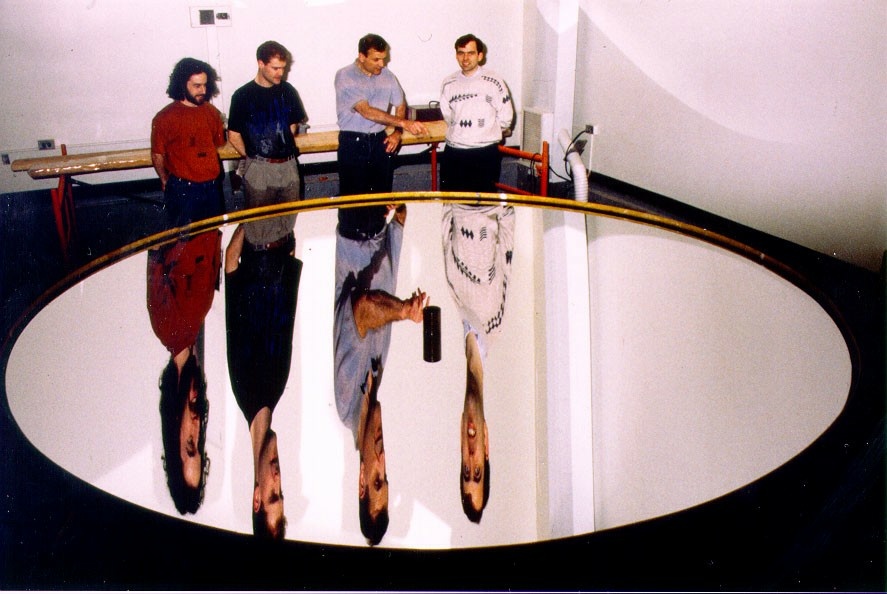
Liquid mirror telescopes differ from conventional telescopes by their primary mirrors—the ones that gather and focus light—which are made from a reflective liquid instead of polished glass. Poured into a spinning container, the liquid spreads out and forms a thin, perfectly smooth, and parabolic shape that can be used as a telescope mirror.


3.7-m diameter liquid mirror at Laval University.

Plants absorb carbon dioxide from the air and combine it with water molecules and sunshine to make carbohydrate or sugar. Variations on this process provide fuel for all of life on Earth.

University of Wisconsin-Madison chemical and biological engineering Professor James Dumesic and his research team describe a two-stage process for turning biomass-derived sugar into 2,5-dimethylfuran (DMF), a liquid transportation fuel with 40 percent greater energy density than ethanol.

The prospects of diminishing oil reserves and the threat of global warming caused by releasing otherwise trapped carbon into the atmosphere have researchers searching for a sustainable, carbon-neutral fuel to reduce global reliance on fossil fuels.