Banner
Pilot Study: Fibromyalgia Fatigue Improved By TENS Therapy

Fibromyalgia is the term for a poorly-understood condition where people experience pain and fatigue...

High Meat Consumption Linked To Lower Dementia Risk

Older people who eat large amounts of meat have a lower risk of dementia and cognitive decline...

Long Before The Inca Colonized Peru, Natives Had A Thriving Trade Network

A new DNA analysis reveals that long before the Incan Empire took over Peru, animals were...

Mesolithic People Had Meals With More Tradition Than You Thought

The common imagery of prehistoric people is either rooting through dirt for grubs and picking berries...

User picture.
News StaffRSS Feed of this column.

News Releases From All Over The World, Right To You... Read More »

Blogroll

The world is abuzz with the discovery of an extrasolar, Earthlike planet around the star Gliese 581 that is relatively close to our Earth at 20 light years away in the constellation Libra.

Bruce Fegley, Jr., Ph.D., professor of earth and planetary sciences in Arts & Sciences at Washington University in St. Louis, has worked on computer models that can provide hints to what comprises the atmosphere of such planets and better-known celestial bodies in our own solar system.

New computer models, from both Earth-based spectroscopy and space mission data, are providing space scientists compelling evidence for a better understanding of planetary atmospheric chemistry.

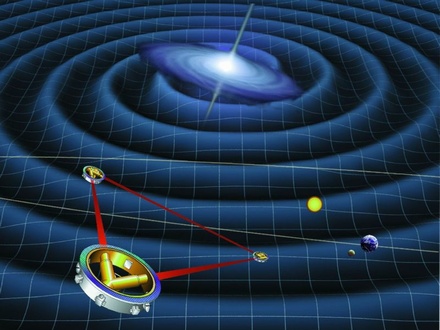
A new way of looking at a previously abandoned mathematical model might help astronomers study and accurately identify an exotic clan of gravitational waves.

The waves in question come from small black holes or neutron stars in extremely elongated orbits around vastly larger black holes, says Dr. Lior Burko, an assistant physics professor at The University of Alabama in Huntsville (UAH). "This reopens an area of research that was closed several years ago."

The exotic gravitational waves are generated (as predicted by general relativity theory) when an orbiting compact object changes speed, accelerating as it approaches the larger black hole and slowing as it moves away.

New studies show that iron, the principal constituent of the innermost parts of the earth’s core, becomes unusually ‘soft’ at the extreme pressures and temperatures that prevail there. The findings enhance our possibility of understanding the innermost parts of the earth and how earthquakes occur.

The findings were attained by a team of Swedish and Russian researchers, who used advanced simulations on Swedish supercomputers. This new knowledge explains some of the seismic data-signals from earth tremors-that stations around the world gather and that have puzzled scientists until now.

“These new discoveries about the innermost part of the earth provide an explanation for the low velocity of the seismic waves deep down in the earth.

Children who have at least one parent who smokes have 5.5 times higher levels of cotinine, a byproduct of nicotine, in their urine, according to a University of Leicester led study published online.

Having a mother that smokes was found to have the biggest independent effect on cotinine in the urine – quadrupling it. Having a smoking father doubled the amount of cotinine, one of chemicals produced when the body breaks down nicotine from inhaled smoke to get rid of it.

Sleeping with parents and lower temperature rooms were also associated with increased amounts of cotinine.

What happens if you deprive a group of 7 and 8 year olds of computers, television and games consoles for two weeks?

Psychologist and head of the Department of Media and Communication at the University of Leicester, Professor Barrie Gunter, has been working with the BBC Panorama team to find out.

Twenty-three 7 and 8-year-old school children from a single year group in a primary school in the Manchester area took part. They included children with a wide cross section of interests, from those who spent their free time in front of a screen to others who led a more active life outside school. Their families were also recruited to take part.

While young people have been going to college in greater numbers over the past 20 years the Scottish higher education rate versus the English has been 'consistently and substantially' greater in Scotland, according to a unique study funded by the Economic and Social Research Council (ESRC).

The project, led by Dr Linda Croxford with Professor David Raffe of the University of Edinburgh, found that while the Scottish system encouraged young people to study beyond the age of 16, middle class students took most advantage.