Banner
Pilot Study: Fibromyalgia Fatigue Improved By TENS Therapy

Fibromyalgia is the term for a poorly-understood condition where people experience pain and fatigue...

High Meat Consumption Linked To Lower Dementia Risk

Older people who eat large amounts of meat have a lower risk of dementia and cognitive decline...

Long Before The Inca Colonized Peru, Natives Had A Thriving Trade Network

A new DNA analysis reveals that long before the Incan Empire took over Peru, animals were...

Mesolithic People Had Meals With More Tradition Than You Thought

The common imagery of prehistoric people is either rooting through dirt for grubs and picking berries...

User picture.
News StaffRSS Feed of this column.

News Releases From All Over The World, Right To You... Read More »

Blogroll

With a technology transfer agreement announced today, the first compact proton therapy system – one that would fit in any major cancer center and cost a fifth as much as a full-scale machine – is one step closer to reality.

Proton therapy is considered the most advanced form of radiation therapy available, but size and cost have limited the technology’s use to only six cancer centers nationwide.


Compact proton radiotherapy treatment concept
Illustration by Steven Hawkins

A team of LLNL researchers has conceptually proven that a three-in-one machine, or “universal point detection system,” that can detect explosive, chemical and biological agents all at the same time, can be achieved, said George Farquar, a postdoctoral fellow and physical chemist at the LLNL’s Glenn T. Seaborg Institute.


Audrey Martin adjusts the lens stack of SPAMS. Martin, who worked at LLNL for 15 weeks last summer as a Department of Homeland Security (DHS) Fellow, is the first DHS intern hired into the Laboratory as a full-time student employee.

At some level, all types of matter that we usually deal with have at least one thing in common - they're made of particles. The solids, liquids, gases and plasmas that surround us are built of atoms, which are made of electrons, protons and neutrons. Protons and neutrons in turn are made of quarks.

According to Harvard University's Howard Georgi, however, there's at least the theoretical possibility that some matter in the universe is not made of particles at all. Georgi has dubbed the mind-bending matter "unparticle stuff," and hopes that we may see signs of it at the Large Hadron Collider (LHC), a super high energy proton collider due to come online in Europe later this year.

Alan Hubert and Dixie Dansercoer collect snow-depth data for ESA's CryoSat-2 mission. They're seasoned polar explorers so they are used to dealing with physically demanding and downright harsh conditions but what they encountered during their three and a half-month expedition from Russia to Greenland via the North Pole was dangerous even for them.

They didn't expect that the Lincoln Sea in the Arctic Ocean, the very ice they were on, would begin to disintegrate. Aside from the dangerous conditions they also had to circumnavigate the ice-free water leads.

Scientists at University College Cork have discovered that probiotic bacteria can protect against bacterial infection. The work was carried out in the Alimentary Pharmabiotic Centre (APC) in UCC.

The APC, funded by Science Foundation Ireland, was set up investigate the beneficial roles of the bacteria found in the gastro-intestine of healthy humans.

The research group examined a range of beneficial bacteria and found one specific probiotic bacterium (Lactobacillus salivarius UCC118) which was able to kill Listeria monocytogenes, an often lethal pathogen in pregnant women. The probiotic kills the pathogen by producing an antibiotic-like compound called a bacteriocin.

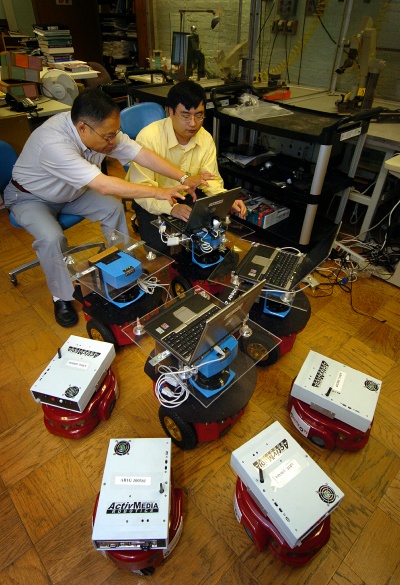
Engineers at Purdue University are developing robots able to make "educated guesses" about what lies ahead as they traverse unfamiliar surroundings, reducing the amount of time it takes to successfully navigate those environments.

The method works by using a new software algorithm that enables a robot to create partial maps as it travels through an environment for the first time. The robot refers to this partial map to predict what lies ahead.

The more repetitive the environment, the more accurate the prediction and the easier it is for the robot to successfully navigate, said C.S.