Banner
Pilot Study: Fibromyalgia Fatigue Improved By TENS Therapy

Fibromyalgia is the term for a poorly-understood condition where people experience pain and fatigue...

High Meat Consumption Linked To Lower Dementia Risk

Older people who eat large amounts of meat have a lower risk of dementia and cognitive decline...

Long Before The Inca Colonized Peru, Natives Had A Thriving Trade Network

A new DNA analysis reveals that long before the Incan Empire took over Peru, animals were...

Mesolithic People Had Meals With More Tradition Than You Thought

The common imagery of prehistoric people is either rooting through dirt for grubs and picking berries...

User picture.
News StaffRSS Feed of this column.

News Releases From All Over The World, Right To You... Read More »

Blogroll

Sharks are known to have a keen sense of smell, which in many species is critical for finding food. However, according to new research from Boston University marine biologists, sharks can not use just their noses to locate prey; they also need their skin – specifically a location called the lateral line.

Inhaling oxygen is only the first step in a long journey through the nooks and crannies of the body. The oxygen is then transported via the blood to all cells in the body. The same goes for nourishment from food we eat. Inside the cell, the oxygen and nourishment are transformed into energy and carbon dioxide, which we breathe out. In a new dissertation from Stockholm University in Sweden, Kristina Faxén has mapped how so-called cell breathing takes place.

A novel analysis of water flow in the Southern Ocean surrounding the Antarctic is revealing previously hidden structures that are crucial in controlling the transport of drifting plants and animals as well as the distribution of nutrients and pollutants that affect ocean life.

Researchers at the University of New South Wales in Australia and the Universitat Paderborn in Germany discovered that barriers to currents, which can lead to swirling gyres and eddies that trap material for long periods, may escape detection with traditional analyses that concentrate on monitoring average water flow or sea surface height.

A University of Alberta research team has combined two fields of study in nanotechnology to create a third field that the researchers believe will lead to revolutionary advances in computer electronics, among many other areas.

Dr. Abdulhakem Elezzabi and his colleagues have applied plasmonics principles to spintronics technology and created a novel way to control the quantum state of an electron's spin.

MultiDetector Computed Tomography (MDCT) can aid forensics teams in determining if a person has drowned, according to a study published in the June issue of Radiology.

MDCT is comparable to conventional autopsy in demonstrating airway froth and sediment that are indicative of drowning.


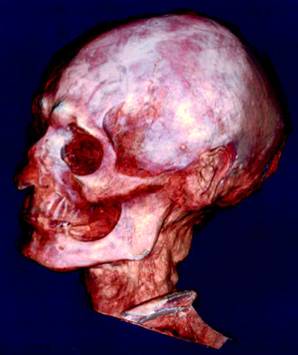
Skull using MDCT. Credit: American Journal of Roentgenology

The world's largest and most prolific team of planet hunters announced today (Monday, May 28) the discovery of 28 new planets outside our solar system, increasing to 236 the total number of known exoplanets.

University of California, Berkeley, post-doctoral fellow Jason T. Wright and newly minted Ph.D. John Asher Johnson reported the new exoplanets at a noon media briefing at the semi-annual meeting of the American Astronomical Society (AAS) in Honolulu.