Banner
Pilot Study: Fibromyalgia Fatigue Improved By TENS Therapy

Fibromyalgia is the term for a poorly-understood condition where people experience pain and fatigue...

High Meat Consumption Linked To Lower Dementia Risk

Older people who eat large amounts of meat have a lower risk of dementia and cognitive decline...

Long Before The Inca Colonized Peru, Natives Had A Thriving Trade Network

A new DNA analysis reveals that long before the Incan Empire took over Peru, animals were...

Mesolithic People Had Meals With More Tradition Than You Thought

The common imagery of prehistoric people is either rooting through dirt for grubs and picking berries...

User picture.
News StaffRSS Feed of this column.

News Releases From All Over The World, Right To You... Read More »

Blogroll

Analyzing 30 years of data detailing a large rabies virus outbreak among North American raccoons, researchers at Emory University have revealed how initial demographic, ecological and genetic processes simultaneously shaped the virus's geographic spread over time. The study appears online in the Proceedings of The National Academy of Sciences.

"Our study demonstrates the combined evolutionary and population dynamic processes characterizing the spread of a pathogen after its introduction into a susceptible host population," says Leslie Real, PhD, Emory University Asa G. Candler professor of biology.

Illinois State University’s Board of Trustees today approved a new bachelor’s degree in renewable energy, which will include a technical sequence and an economics and public policy sequence.

The degree is a multi-disciplinary undergraduate major that provides a broad overview of renewable energy industries. Renewable energy is a fast-growing industry that will call for many new workers in the future.

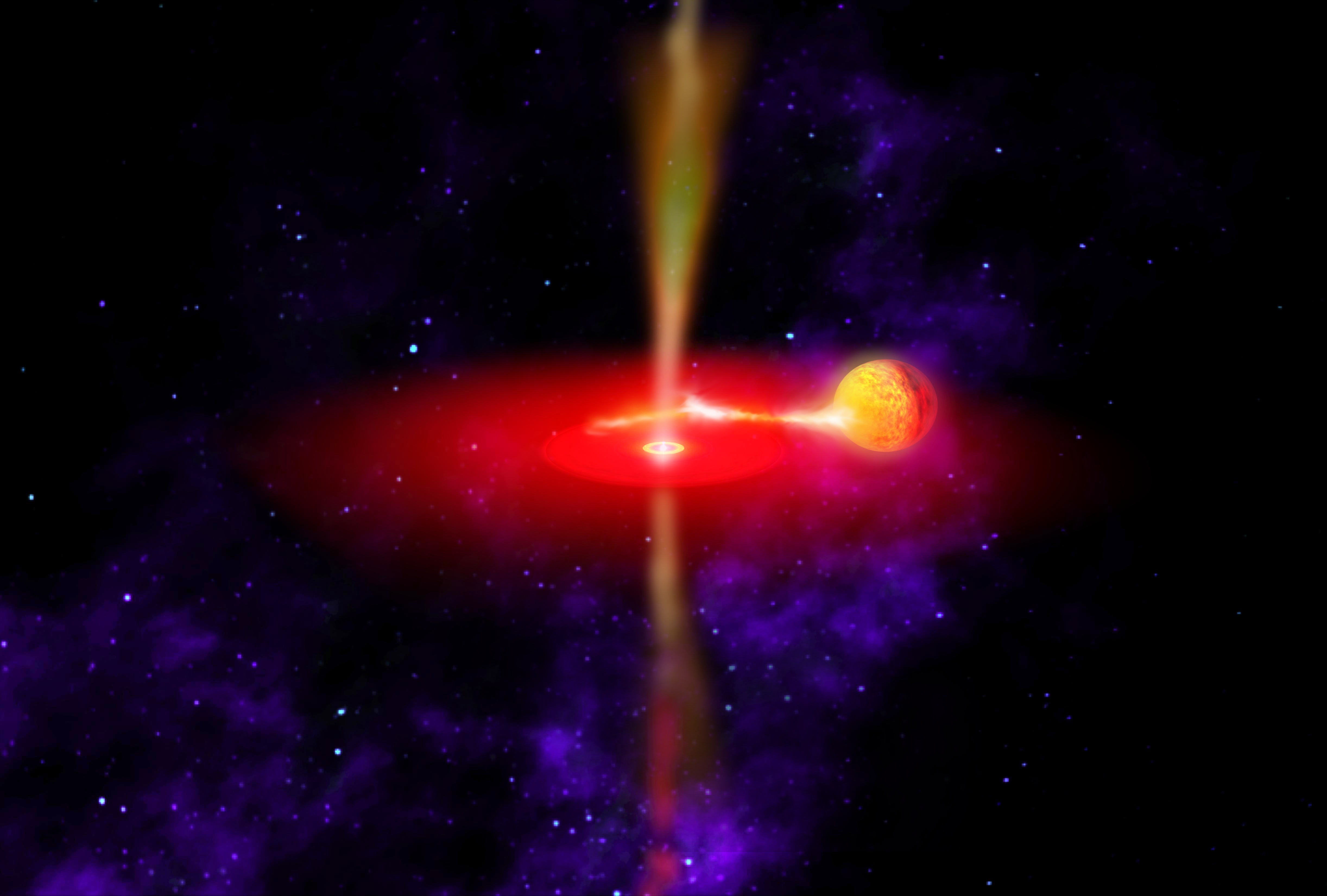
Two astrophysicists at NASA’s Goddard Space Flight Center in Greenbelt, Md., Nikolai Shaposhnikov and Lev Titarchuk, have successfully tested a new method for determining the masses of black holes.

This elegant technique, which Titarchuk first suggested in 1998, shows that the black hole in a binary system known as Cygnus X-1 contains 8.7 times the mass of our sun, with a margin of error of only 0.8 solar mass.


CLICK IMAGE FOR LARGER VERSION.

Researchers at Rensselaer Polytechnic Institute have developed a new method to bond materials that don’t normally stick together. The team’s adhesive, which is based on self-assembling nanoscale chains, could impact everything from next-generation computer chip manufacturing to energy production.

Less than a nanometer – or one billionth of a meter – thick, the nanoglue is inexpensive to make and can withstand temperatures far higher than what was previously envisioned. In fact, the adhesive’s molecular bonds strengthen when exposed to heat.

The increase in the number of diagnosed cases of autism in recent years has sparked concern that environmental toxins may cause this complex disorder. A new study found, however, that exposure to Rh immune globulin preserved with mercury-containing thimerosal before birth was no higher for children with autism. The study was led by Judith Miles at the University of Missouri-Columbia.

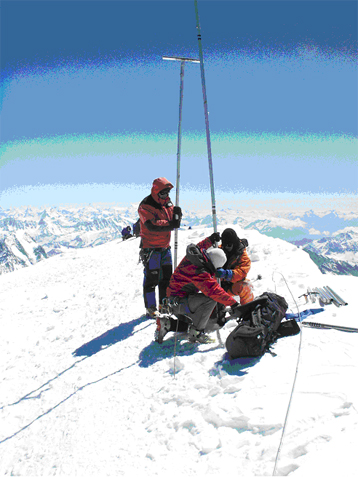
The small ice caps of Mont Blanc and the Dôme du Goûter are not melting, or at least, not yet. This is what CNRS researchers have announced in the Journal of Geophysical Research. At very high altitudes (above 4200 meters), the accumulation of snow and ice has varied very little since the beginning of the 20th century. But if summer temperatures increase by a few degrees during the 21st century, the melt could become more marked, and could affect the "permanent" ice fields.


Figure 1 – Researchers from the Glaciology Laboratory taking an ice core sample on top of Mont Blanc, in 2005. © C. Vincent, CNRS 2007.