Banner
Pilot Study: Fibromyalgia Fatigue Improved By TENS Therapy

Fibromyalgia is the term for a poorly-understood condition where people experience pain and fatigue...

High Meat Consumption Linked To Lower Dementia Risk

Older people who eat large amounts of meat have a lower risk of dementia and cognitive decline...

Long Before The Inca Colonized Peru, Natives Had A Thriving Trade Network

A new DNA analysis reveals that long before the Incan Empire took over Peru, animals were...

Mesolithic People Had Meals With More Tradition Than You Thought

The common imagery of prehistoric people is either rooting through dirt for grubs and picking berries...

User picture.
News StaffRSS Feed of this column.

News Releases From All Over The World, Right To You... Read More »

Blogroll

Combining diamond anvils and powerful lasers, laboratory researchers have developed a technique that should be able to squeeze materials to pressures 100 to 1,000 times greater than possible today, reproducing conditions expected in the cores of supergiant planets.

Until now, these pressures have only been available experimentally next to underground nuclear explosions.

There is renewed hope for treatment of a rare genetic condition, Progeria, that causes rapidly accelerated aging and leads to an average life expectancy of 13 years.

Scientists studying the genes of two infants who died of mysterious illnesses found the infants had mutations in LMNA, the same gene altered in patients with the premature aging condition. But the infants' unusual mutations caused them to make many more bad copies of the gene's primary protein, lamin A, than progeria patients.

Great Tits are, of course, songbirds - specifically Parus major. An international team of researchers have now found evidence for the existence of a "curiosity-gene" in our feathered friends.

The gene (Drd4) carries the building instructions for a receptor in the brain, which forms the docking station for the neurotransmitter dopamine. Birds with a specific variant of this dopamine receptor D4 gene show a stronger exploratory behaviour than individuals with other variants.


A hungry great tit is interested in the food on the table (left), but will remain hungry if he is too shy to approach the unknown object (right). Credit: Kees van Oers

New observations by the NASA/ESA Hubble Space Telescope have overturned conventional ideas about the early life of some massive globular clusters, showing that they can go through several periods of intense stellar formation rather than the previously accepted single burst. The analysis of Hubble data from the massive globular cluster NGC 2808 provides evidence that star birth occurred over three generations early in the cluster's life.


This NASA/ESA Hubble Space Telescope image of a dense swarm of stars shows the central region of the globular cluster NGC 2808. Astronomers were surprised when Hubble spied three generations of cluster stars.

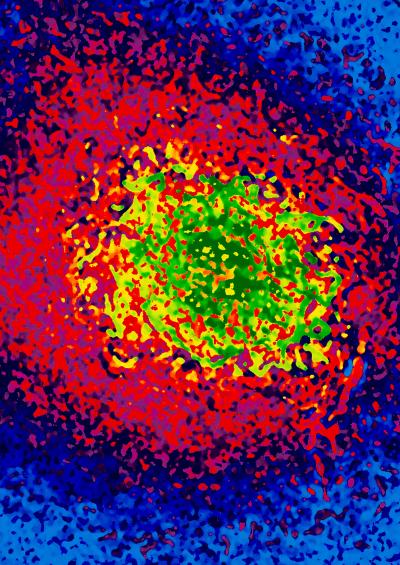
Collaborative research between scientists in the UK and USA has led to a major breakthrough in the understanding of antiferromagnets, published in this week's Nature. Scientists at the London Centre for Nanotechnology, the University of Chicago and the Center for Nanoscale Materials at Argonne National Laboratory have used x-rays to see the internal workings of antiferromagnets for the very first time.


By observing changes in coherent X-ray speckle pattern, such as the one shown above, researchers are able for the first time to investigate nanoscale dynamics of antiferromagnetic domain walls, and observe a cross over from classical to quantum behavior. Credit: O.

When it comes to studying energy transfer in photosynthesis, it's good to think "outside the bun."

That's what Robert Blankenship, Ph.D., professor of biology and chemistry in Arts & Sciences at Washington University in St. Louis, did when he contributed a protein to a study performed by his collaborators at Lawrence Berkeley National Laboratory and the University of California at Berkeley. The protein's moniker? The taco shell protein.