Banner
Pilot Study: Fibromyalgia Fatigue Improved By TENS Therapy

Fibromyalgia is the term for a poorly-understood condition where people experience pain and fatigue...

High Meat Consumption Linked To Lower Dementia Risk

Older people who eat large amounts of meat have a lower risk of dementia and cognitive decline...

Long Before The Inca Colonized Peru, Natives Had A Thriving Trade Network

A new DNA analysis reveals that long before the Incan Empire took over Peru, animals were...

Mesolithic People Had Meals With More Tradition Than You Thought

The common imagery of prehistoric people is either rooting through dirt for grubs and picking berries...

User picture.
News StaffRSS Feed of this column.

News Releases From All Over The World, Right To You... Read More »

Blogroll

The rise of the central nervous system (CNS) in animal evolution has puzzled scientists for centuries. Vertebrates, insects and worms evolved from the same ancestor, but their CNSs are different and were thought to have evolved only after their lineages had split during evolution. Researchers from the European Molecular Biology Laboratory (EMBL) in Heidelberg now reveal that the vertebrate nervous system is probably much older than expected. The study, which is published in the current issue of Cell, suggests that the last common ancestor of vertebrates, insects and worms already had a centralised nervous system resembling that of vertebrates today.

People who significantly cut back on the amount of salt in their diet could reduce their chances of developing cardiovascular disease by a quarter, according to a report on bmj.com today.

Researchers in Boston also found a reduction in salt intake could lower the risk of death from cardiovascular disease by up to a fifth.

Strawberries are good for you, but serving them in daiquiri form may make them even healthier, scientists show.

While exploring ways to help keep strawberries fresh during storage, researchers from Thailand and the US discovered that treating the berries with alcohol led to an increase in antioxidant capacity and free radical scavenging activity within the fruit. While such a boost helped the berries resist decay, the same compounds would also be expected to make the strawberries healthier to eat.

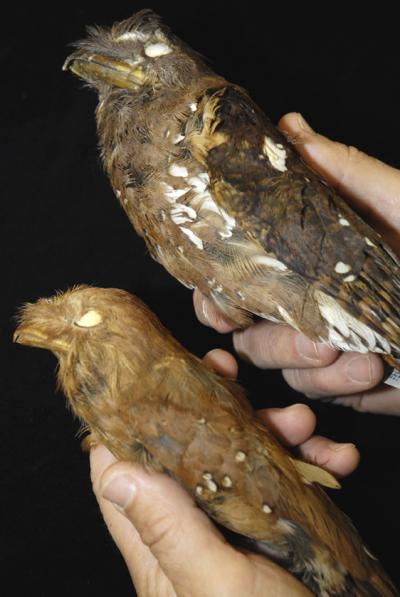
Your bird field guide may be out of date now that University of Florida scientists discovered a new genus of frogmouth bird on a South Pacific island.

New genera of living birds are rare discoveries — fewer than one per year is announced globally. David Steadman and Andrew Kratter, ornithologists at the Florida Museum of Natural History, turned up the surprising new discovery on a collecting expedition in the Solomon Islands. Theirs is the first frogmouth from these islands to be caught by scientists in more than 100 years. They immediately recognized it was something different.


A new genus of frogmouth bird is seen in the top right of this photograph taken April 18, 2007.

Green tea may help protect against autoimmune disease, Medical College of Georgia researchers say.

Researchers studied an animal model for type I diabetes and primary Sjogren's Syndrome, which damages the glands that produce tears and saliva.

There's a "First Light Fiesta" in the works at Mt. Hopkins near Amado, Ariz. And Iowa State University astrophysicists will be among those enjoying the celebration of a new telescope system and all the science it will produce.


Iowa State University astrophysicists designed and built four of these cameras for the VERITAS gamma ray telescope system. Each camera contains 500 tube-shaped photo detectors. Credit: Photo contributed by Frank Krennrich/Iowa State University