Banner
Pilot Study: Fibromyalgia Fatigue Improved By TENS Therapy

Fibromyalgia is the term for a poorly-understood condition where people experience pain and fatigue...

High Meat Consumption Linked To Lower Dementia Risk

Older people who eat large amounts of meat have a lower risk of dementia and cognitive decline...

Long Before The Inca Colonized Peru, Natives Had A Thriving Trade Network

A new DNA analysis reveals that long before the Incan Empire took over Peru, animals were...

Mesolithic People Had Meals With More Tradition Than You Thought

The common imagery of prehistoric people is either rooting through dirt for grubs and picking berries...

User picture.
News StaffRSS Feed of this column.

News Releases From All Over The World, Right To You... Read More »

Blogroll

Much of the research surrounding childhood asthma has sought new approaches to managing the disease. However, little was done to address other conditions that often appear along with asthma including depression and Attention Deficit Hyperactivity Disorder (ADHD), which can negatively affect a child’s ability to cope.

Research completed at the University of Virginia Children’s Hospital asserts that until these extra conditions or "co-morbidities" are addressed, asthma education programs will not be able to help young patients to the fullest. The results will be published in the April 12 issue of The Journal of Developmental and Behavioral Pediatrics.

Since the 2001 launch of the Human Genome Project, which released a first draft of the entire sequence of human DNA, many researchers have dedicated themselves to creating a library of comprehensive, species-specific genetic sequence "maps" available for study. Scientists at LSU recently took part in the International Rhesus Macaque Sequence and Analysis Consortium, which successfully detailed the full DNA sequence of the rhesus macaque, the third primate – including humans – to undergo sequencing. The results will be published in the journal Science on Friday, April 13.

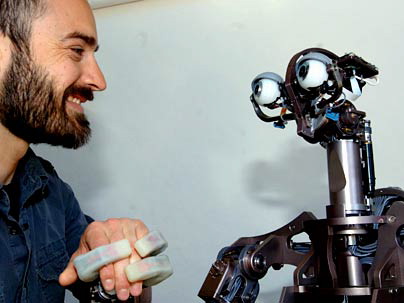
At MIT, researchers are working on an early version of intelligent, robotic helpers--a humanoid called Domo who grasp objects and place them on shelves or counters. Domo is the "next generation" of earlier robots built at MIT-Kismet, which was designed to interact with humans, and Cog, which could learn to manipulate unknown objects.

In the futuristic cartoon series "The Jetsons," a robotic maid named Rosie whizzed around the Jetsons' home doing household chores--cleaning, cooking dinner and washing dishes. The technology is not quite there yet.

The powerful earthquake struck suddenly, shaking the seven-story building so hard it bent, cracked and swayed in response.

But this was no ordinary earthquake. In a groundbreaking series of tests, engineering researchers from UC San Diego's Jacobs School of Engineering jarred a full-size 275-ton building erected on a shake table, duplicating ground motions recorded during the January 17, 1994 1994 Northridge earthquake in Los Angeles, California.

Michael Marmor, MD, wanted to know what it was like to see through the eyes of an artist. Literally.

After writing two books on the topic of artists and eye disease, the Stanford University School of Medicine ophthalmologist decided to go one step further and create images that would show how artists with eye disease actually saw their world and their canvases.

Researchers from the Boston University Center for Remote Sensing used recently acquired topographic data from satellites to reveal an ancient mega-lake in the Darfur province of northwestern Sudan. Drs. Eman Ghoneim and Farouk El-Baz made the finding while investigating Landsat images and Radarsat data. Radar waves are able to penetrate the fine-grained sand cover in the hot and dry eastern Sahara to reveal buried features.


Northern Darfur Mega-Lake. Credit: Boston University Center for Remote Sensing