Banner
Pilot Study: Fibromyalgia Fatigue Improved By TENS Therapy

Fibromyalgia is the term for a poorly-understood condition where people experience pain and fatigue...

High Meat Consumption Linked To Lower Dementia Risk

Older people who eat large amounts of meat have a lower risk of dementia and cognitive decline...

Long Before The Inca Colonized Peru, Natives Had A Thriving Trade Network

A new DNA analysis reveals that long before the Incan Empire took over Peru, animals were...

Mesolithic People Had Meals With More Tradition Than You Thought

The common imagery of prehistoric people is either rooting through dirt for grubs and picking berries...

User picture.
News StaffRSS Feed of this column.

News Releases From All Over The World, Right To You... Read More »

Blogroll

Scientists using NASA satellite data have found strong evidence that a major earthquake can lead to a nearly immediate increase in regional volcanic activity.

The intensity of two ongoing volcanic eruptions on Indonesia’s Java Island increased sharply three days following a powerful, 6.4-magnitude earthquake on the island in May 2006. The increased volcanic activity persisted for about nine days.

In a study appearing in the March 22 New England Journal of Medicine, scientists supported by the National Institutes of Health’s National Institute of Arthritis and Musculoskeletal and Skin Diseases (NIAMS) have discovered a connection between a specific gene and the inflammatory skin condition vitiligo, as well as a possible host of autoimmune diseases.

Vitiligo is a chronic condition in which melanocytes (the cells that make pigment) in the skin are destroyed. As a result, white patches appear on the skin in different parts of the body. Similar patches also appear on both the mucous membranes (tissues that line the inside of the mouth and nose), and perhaps in the retina (inner layer of the eyeball).

The 11,000 members of three scientific societies with its roots in agriculture have been closely watching the reports coming out of the Intergovernmental Panel on Climate Change (IPCC).

It is the IPCC’s 4th Assessment Report released on April 6, "Climate Change 2007: The Physical Science Basis" that points to the direct consequences of climate change. Leading scientists from all over the world contributed to the latest installment of this report that attributes ecosystem changes to human-induced global warming. Following the release of the report, the presidents of the American Society of Agronomy (ASA), Crop Science Society of America (CSSA), and Soil Science Society of America (SSSA) issued this statement today:

Got milk? Weightlifters will want to raise a glass after a new study found that milk protein is significantly better than soy at building muscle mass.

The study, conducted by a team of researchers at McMaster University’s Department of Kinesiology, was recently published in the American Journal of Clinical Nutrition. It compared how much muscle protein young men gained after completing a heavy weight workout followed by consumption of equivalent amounts of protein as either fluid skim milk or a soy drink.

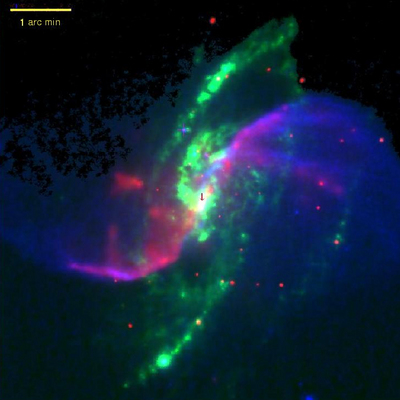
Using a trio of space observatories, astronomers may have cracked a 45-year old mystery surrounding two ghostly spiral arms in the galaxy M106 (NGC 4258).

The results, obtained by a team from the University of Maryland (USA), took advantage of the unique capabilities of the European Space Agency’s XMM-Newton X-ray observatory, NASA’s Chandra X-ray Observatory, and NASA’s Spitzer Space Telescope.


This is a composite image of spiral galaxy M106 (NGC 4258). Optical data from the Digitized Sky Survey is shown in yellow, radio data from the Very Large Array appears purple, X-ray data from Chandra is coded blue, and infrared data from the Spitzer Space Telescope appears red.

Marine scientists recently published a research paper in the science journal, biology letters, that found humpback whales migrate over 5,100 miles from Central America to their feeding grounds off Antarctica; a record distance undertaken by any mammal.

Kristin Rasmussen, a biologist with Cascadia Research Collective, and lead author in the study, finds the record-breaking migration interesting, but is most pleased that the study validates a long held assumption that humpback whales travel to warm water areas during the winter.