Banner
Pilot Study: Fibromyalgia Fatigue Improved By TENS Therapy

Fibromyalgia is the term for a poorly-understood condition where people experience pain and fatigue...

High Meat Consumption Linked To Lower Dementia Risk

Older people who eat large amounts of meat have a lower risk of dementia and cognitive decline...

Long Before The Inca Colonized Peru, Natives Had A Thriving Trade Network

A new DNA analysis reveals that long before the Incan Empire took over Peru, animals were...

Mesolithic People Had Meals With More Tradition Than You Thought

The common imagery of prehistoric people is either rooting through dirt for grubs and picking berries...

User picture.
News StaffRSS Feed of this column.

News Releases From All Over The World, Right To You... Read More »

Blogroll

The theory that Earth once underwent a prolonged time of extreme global freezing has been dealt a blow by new evidence that periods of warmth occurred during this so-called 'Snowball Earth' era.

Analyses of glacial sedimentary rocks in Oman, published online today in Geology, have produced clear evidence of hot-cold cycles in the Cryogenian period, roughly 850-544 million years ago. The UK-Swiss team claims that this evidence undermines hypotheses of an ice age so severe that Earth's oceans completely froze over.

Scientists from the NIOZ Royal Netherlands Institute for Sea Research obtained for the first time a detailed temperature record for tropical central Africa over the past 25,000 years. They did this in cooperation with a German colleague from the University of Bremen, The scientists developed an entirely new method to reconstruct the history of land temperatures based on the molecular fossils of soil bacteria. They applied the method to a marine sediment core taken in the outflow of the Congo River. This core contained eroded land material and microfossils from marine algae. The results show that the land environment of tropical Africa was cooled more than the adjacent Atlantic Ocean during the last ice-age.

Fresh evidence that suggests monkeys can learn skills from each other, in the same manner as humans, has been uncovered by a University of Cambridge researcher.

Dr Antonio Moura, a Brazilian researcher from the Department of Biological Anthropology, has discovered signs that Capuchin monkeys in Brazil bang stones as a signalling device to ward off potential predators.

Tissue engineering is a relatively new field of basic and clinical science that is concerned, in part, with creating tissues that can augment or replace injured, defective, or diseased body parts. The approach to fabricating the tissues involves adding specific cell types to grow on a polymer scaffold having the shape of the tissue to be restored. The scaffold gradually disappears, while the cells continue developing in the scaffold shape. With the use of non-human animal cells, there has been considerable recent progress made in the engineering of skin, bladder, cartilage, and several other tissues.

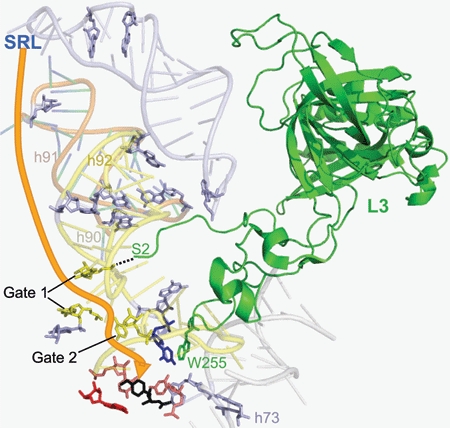
The ribosome is the protein-producing nanomachine in cells that keeps the human body cranking along.

Researchers at Purdue University and The Catholic University of America have discovered the structure of an enzyme essential for the operation of "molecular motors" that package DNA into the head segment of some viruses during their assembly.

The enzyme, called an ATPase, provides energy to run the motor needed to insert DNA into the capsid, or head, of the T4 virus, which is called a bacteriophage because it infects bacteria. The same kind of motor, however, also is likely present in other viruses, including the human herpes virus.


This image depicts the structure of the T4 virus, called a bacteriophage because it infects bacteria.