Banner
Pilot Study: Fibromyalgia Fatigue Improved By TENS Therapy

Fibromyalgia is the term for a poorly-understood condition where people experience pain and fatigue...

High Meat Consumption Linked To Lower Dementia Risk

Older people who eat large amounts of meat have a lower risk of dementia and cognitive decline...

Long Before The Inca Colonized Peru, Natives Had A Thriving Trade Network

A new DNA analysis reveals that long before the Incan Empire took over Peru, animals were...

Mesolithic People Had Meals With More Tradition Than You Thought

The common imagery of prehistoric people is either rooting through dirt for grubs and picking berries...

User picture.
News StaffRSS Feed of this column.

News Releases From All Over The World, Right To You... Read More »

Blogroll

Ultrasonic irradiation can break down ionic liquids into more environmentally benign compounds, say scientists.

Ionic liquids are widely regarded as a greener alternative to many commonly used solvents. But, concerns about their toxicity have raised questions about their use in large scale industrial applications, especially those that involve the creation of large amounts of waste.


High frequency sound waves break ionic liquids into non-toxic components. Image: Chemical Science

Scientists of the University of Almeria, led by Gabriel Acién, are carrying out a research project on the development of new systems to eliminate carbon dioxide emissions thanks to the microalgae photosynthetic activity. This project, called CENIT CO2, is being developed by Spanish electricity company Endesa on the initiative of the Spanish Ministry of Industry.

On the pilot plant developed at the experimental station of Las Palmerillas, which depends on Spanish bank Cajamar, Almeria-based researchers try to prove the validity of this new method for eliminating CO2 emissions. It seems that in one year time, the system will be fully operative and therefore tests can be started at an industrial level.

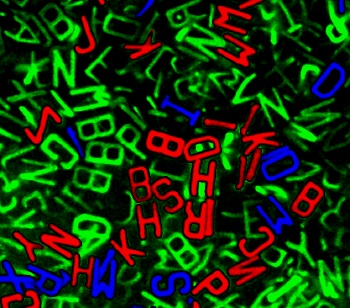
UCLA scientists have designed and mass-produced billions of fluorescent microscale particles in the shapes of all 26 letters of the alphabet in an “alphabet soup” displaying “exquisite fidelity of the shapes.”

The letters are made of solid polymeric materials dispersed in a liquid solution. The research will be published March 29 in the Journal of Physical Chemistry C, where it will be illustrated on the cover. The scientists anticipate that their “LithoParticles” will have significant technological and scientific uses.

“We can even choose the font style; if we wanted Times New Roman, we could produce that,” said study co-author Thomas G.

After years of results that repeatedly dogged him, University of Oregon geologist Douglas R. Toomey decided to follow the trail of data surfacing from the Pacific Ocean. In doing so, he and his collaborators may have altered long-held assumptions involving plate tectonics on the ocean floor.

Reporting in the March 22 issue of Nature, Toomey and co-authors from four other institutions propose that, one, the flow in the Earth's mantle is rotated beneath the East Pacific Rise, causing the plate boundary to change orientation with time. Secondly, they argue that deep-sea hydrothermal vents frequently form above volcanoes where upwelling of the mantle and spreading of the plates are aligned.

The inventors of self-healing plastic have come up with another invention: a new way of doing chemistry.

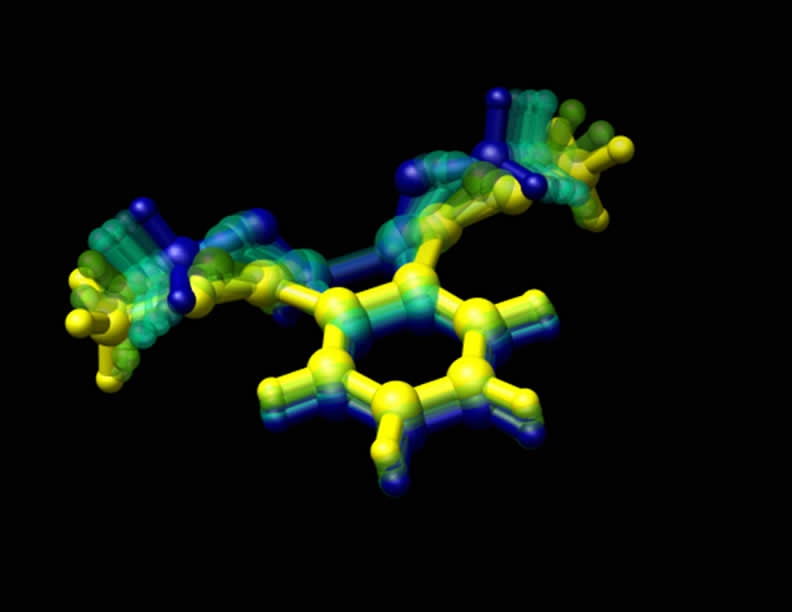
Researchers at the University of Illinois at Urbana-Champaign have found a novel way to manipulate matter and drive chemical reactions along a desired direction. The new technique utilizes mechanical force to alter the course of chemical reactions and yield products not obtainable through conventional conditions.


An overlay of images at successive stages of force-induced chemical change. The blue image is the start of the reaction. The yellow image represents the end of the reaction. Graphic by Ashley Levato

Research funded by Metallica?

Gifted students who feel the pressure of their ability could be using Heavy Metal music to get rid of negative emotions.

This is the conclusion of Stuart Cadwallader and Professor Jim Campbell of The National Academy for Gifted and Talented Youth at the University of Warwick. They will discuss their findings at the British Psychological Society’s Annual Conference at the University of York on Wednesday 21 March 2007.