Banner
Pilot Study: Fibromyalgia Fatigue Improved By TENS Therapy

Fibromyalgia is the term for a poorly-understood condition where people experience pain and fatigue...

High Meat Consumption Linked To Lower Dementia Risk

Older people who eat large amounts of meat have a lower risk of dementia and cognitive decline...

Long Before The Inca Colonized Peru, Natives Had A Thriving Trade Network

A new DNA analysis reveals that long before the Incan Empire took over Peru, animals were...

Mesolithic People Had Meals With More Tradition Than You Thought

The common imagery of prehistoric people is either rooting through dirt for grubs and picking berries...

User picture.
News StaffRSS Feed of this column.

News Releases From All Over The World, Right To You... Read More »

Blogroll

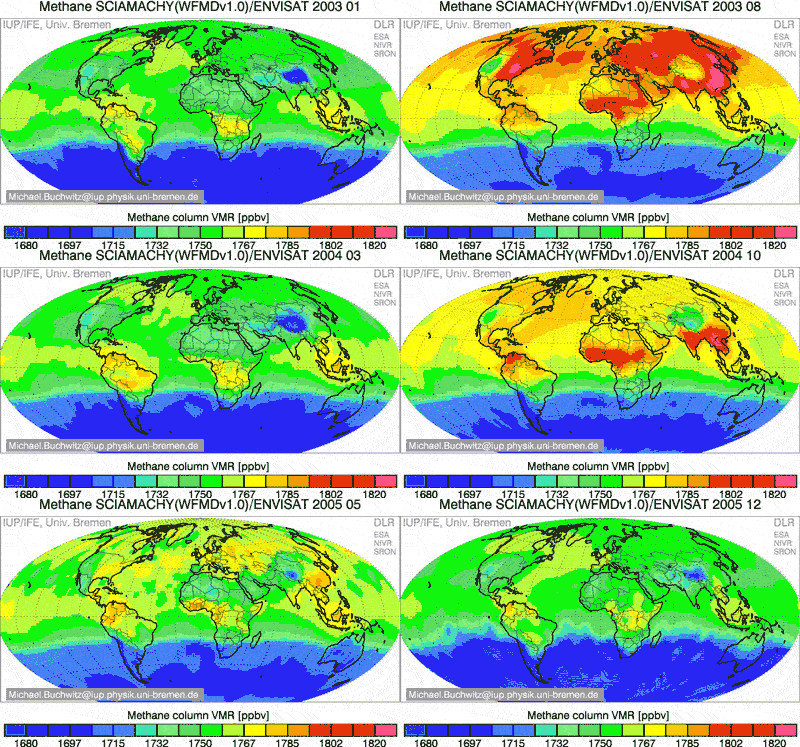
Based on three years of observations from the SCIAMACHY instrument aboard ESA's Envisat, scientists have produced the first movies showing the global distribution of the most important greenhouse gases – carbon dioxide and methane – that contribute to global warming.

The importance of cutting emissions from these 'anthropogenic', or manmade, gases has been highlighted recently with European Union leaders endorsing binding targets to cut greenhouse gases by at least 20 percent from 1990 levels by 2020. Further illustrating the urgency to combat global warming, Britain became the first country last week to propose legislation for cutting the gases.

Using lasers and tuning forks, researchers at Pacific Northwest National Laboratory have developed a chemical weapon agent sensing technique that promises to meet or exceed current and emerging defense and homeland security chemical detection requirements. The technique, called Quartz Laser Photo-Acoustic Sensing, or "QPAS," is now ready for prototyping and field testing.

PNNL, a Department of Energy national laboratory, has demonstrated QPAS's ability to detect gaseous nerve agent surrogates. In one test, researchers used diisopropyl methyl phosphonate (DIMP), which is a chemical compound that's similar to sarin. QPAS detected DIMP at the sub-part-per-billion level in less than one minute.

Scientists' inability to follow the whereabouts of cells injected into the human body has long been a major drawback in developing effective medical therapies. Now, researchers at Johns Hopkins have developed a promising new technique for noninvasively tracking where living cells go after they are put into the body. The new technique, which uses genetically encoded cells producing a natural contrast that can be viewed using magnetic resonance imaging (MRI), appears much more effective than present methods used to detect injected biomaterials.

Described in the February edition of Nature Biotechnology, the method was developed by a team of researchers from Johns Hopkins' Russell H.

Laws in two states requiring disclosure of pharmaceutical company payments to physicians do not provide the public with easy access to payment information and are of limited quality when accessed, according to a study in the March 21 issue of JAMA.

Interactions between the pharmaceutical industry and health care professionals often involve payments, including cash, gift certificates, meals, textbooks or conference fees. In contrast to many other professions, medicine allows payments from a company to an individual who decides whether and how often to use products produced by the company.

According to the Centers for Disease Control (CDC), adolescents and young adults currently account for fifty percent of new HIV infections on an annual basis. As a result, ongoing research and information on HIV prevention has become a high priority for this age group. Now a new study reveals that helping adolescents manage their emotions may be just as important as providing them with information on the practical side of safe sex in order to prevent HIV and other sexually transmitted infections.

Researchers from the Bradley Hasbro Children's Research Center and the Warren Alpert Medical School of Brown University studied 222 adolescents between the ages of 13 and 18 with psychiatric disorders and found that feelings do matter when it comes to making decisions about safe sex.

Hurricanes Katrina and Rita focused the international spotlight on the vulnerability of the U.S. coastline. Fears that a "super-hurricane" could make a direct hit on a major city and cause even more staggering losses of life, land and economy triggered an outpouring of studies directed at every facet of this ferocious weather phenomenon. Now, an LSU professor takes us one step closer to predicting the future by drilling holes into the past.

Kam-biu Liu, George William Barineau III Professor in LSU's Department of Oceanography and Coastal Sciences, is the pioneer of a relatively new field of study called paleotempestology, or the study of prehistoric hurricanes.