Banner
Pilot Study: Fibromyalgia Fatigue Improved By TENS Therapy

Fibromyalgia is the term for a poorly-understood condition where people experience pain and fatigue...

High Meat Consumption Linked To Lower Dementia Risk

Older people who eat large amounts of meat have a lower risk of dementia and cognitive decline...

Long Before The Inca Colonized Peru, Natives Had A Thriving Trade Network

A new DNA analysis reveals that long before the Incan Empire took over Peru, animals were...

Mesolithic People Had Meals With More Tradition Than You Thought

The common imagery of prehistoric people is either rooting through dirt for grubs and picking berries...

User picture.
News StaffRSS Feed of this column.

News Releases From All Over The World, Right To You... Read More »

Blogroll

TOKYO 02/03/2007

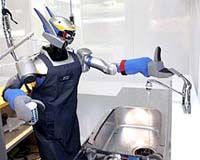
Japan's advanced humanoids can now serve tea and wash the cup afterwards, but they still need to learn from their mistakes if they are to become real household helpers.

A Tokyo University team this week showed their latest robots which can perform more complicated daily tasks, but the machines still have a learning curve.


Japan's advanced humanoids can now serve tea and wash the cup afterwards, but they still need to learn from their mistakes if they are to become real household helpers. © AFP,Ken Shimizu

The European Molecular Biology Laboratory [EMBL] has developed a new computational tool that makes images obtained with cutting-edge microscopes even sharper. The technological advance and its applications are published in this week's online issue of the journal Nature Methods.

Since the Single Plane Illumination Microscope [SPIM] was developed at EMBL in the early 2000s it turned into one of the most powerful tools in cell biology. SPIM allows scientists to study large, living specimen along many different angles, under real conditions and with minimal harm to the specimen.

Brain damage that was thought to be caused by hypoglycemic coma actually occurs when glucose is administered to treat the coma, according to a study in rodents led by researchers at the San Francisco VA Medical Center.

The results are surprising, say the authors, and may be of clinical significance for the treatment of diabetics in hypoglycemic coma, though they caution that the results cannot be immediately extrapolated to humans.

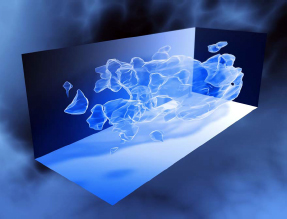
By analyzing the COSMOS field, the largest field of galaxies ever observed with the Hubble space telescope, an international team of scientists led by researchers from the California Institute of Technology (United States) and researchers from the associated laboratories of the CNRS and the CEA , made the first three-dimensional map of dark matter in the Universe using gravitational lensing effects. This historic first seems to confirm the standard theories on the formation of the large structures of the Universe. This study was presented in the January 7, 2007 issue of the journal "Nature."


Three-dimensional map of black matter in the COSMOS field. © ESA/NASA

The chemical bond between carbon and fluorine is one of the strongest in nature, and has been both a blessing and a curse in the complex history of fluorocarbons.


The changing Larsen-B Ice Shelf captured by Envisat on 22 February 2007 with its Advanced Synthetic Aperture Radar (ASAR). The Larsen Ice Shelf is a series of three shelves – A (the smallest), B and C (the largest) – that extend from north to south along the eastern side of the Antarctic Peninsula. Changes in ice shelves are believed to be indicators of climate change, as evidence suggests high latitudes experience the greatest atmospheric warming. Credits: ESA