Banner
Pilot Study: Fibromyalgia Fatigue Improved By TENS Therapy

Fibromyalgia is the term for a poorly-understood condition where people experience pain and fatigue...

High Meat Consumption Linked To Lower Dementia Risk

Older people who eat large amounts of meat have a lower risk of dementia and cognitive decline...

Long Before The Inca Colonized Peru, Natives Had A Thriving Trade Network

A new DNA analysis reveals that long before the Incan Empire took over Peru, animals were...

Mesolithic People Had Meals With More Tradition Than You Thought

The common imagery of prehistoric people is either rooting through dirt for grubs and picking berries...

User picture.
News StaffRSS Feed of this column.

News Releases From All Over The World, Right To You... Read More »

Blogroll
USC's lego-like autonomous robotic units show off ability to reconfigure into different systems for different tasks.

Wei-Min Shen of the University of Southern California's Information Sciences Institute recently reported to NASA significant progress in developing "SuperBot," identical modular units that plug into each other to create robots that can stand, crawl, wiggle and even roll. He illustrated his comments with striking video of the system in action, video now posted on line. 

A Binghamton University researcher has established a new framework to help determine whether individuals might be at risk for schizophrenia.

In a study published in this month's Journal of Abnormal Psychology, Mark F. Lenzenweger, a professor of clinical science, neuroscience and cognitive psychology at Binghamton University, State University of New York (SUNY), is the first to have found that abnormalities in eye movements and attention can be used to divide people into two groups in relation to schizophrenia-related risk.

"Schizophrenia affects one in every 100 people," said Lenzenweger, who considers it the costliest form of mental illness known to humankind.

The ESO Very Large Telescope Interferometer, which allows astronomers to scrutinise objects with a precision equivalent to that of a 130-m telescope, is proving itself an unequalled success every day. One of the latest instruments installed, AMBER, has led to a flurry of scientific results, an anthology of which is being published this week as special features in the research journal Astronomy & Astrophysics.

"With its unique capabilities, the VLT Interferometer (VLTI) has created itself a niche in which it provide answers to many astronomical questions, from the shape of stars, to discs around stars, to the surroundings of the supermassive black holes in active galaxies," says Jorge Melnick (ESO), the VLT Project Scientist.

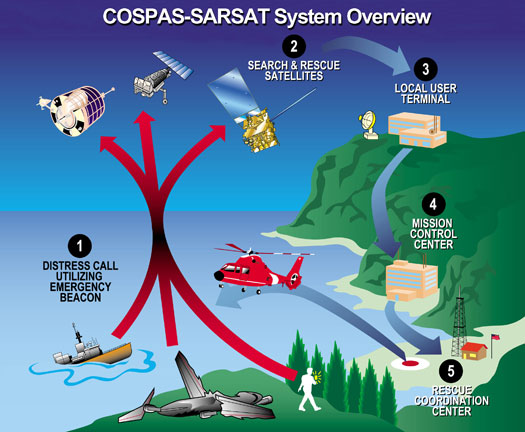
MOSCOW. (Yury Zaitsev for RIA Novosti) - Thirty years ago the Soviet government issued a resolution on setting up a space-based system to search for ships in distress (known by its initials in Russian, KOSPAS) anywhere in the world.

The quick location of such ships reduced by nearly tenfold the time of rescue operations in comparison with the usual methods and also reduced the risk of accidents involving rescue ships and aircraft themselves. For Russia, with its vast, sparsely populated areas and enormous expanses of ocean, creating an effective search-and-rescue system was of significant importance both socially and economically.

Science doesn’t always happen at a lab bench. For University of Toronto Mississauga physicist Kent Moore, it happens while strapped into a four-point harness, flying head-on into hurricane-force winds off the southern tip of Greenland.

Moore, chair of the Department of Chemical and Physical Sciences, is heading to Greenland from Feb. 18 to March 11 as part of the Greenland Flow Distortion experiment (GFDex), an International Polar Year research project involving Canadian, British, Norwegian and Icelandic scientists. Moore, a professor of atmospheric physics, is leading the Canadian contingent.


Credit: University of Toronto.

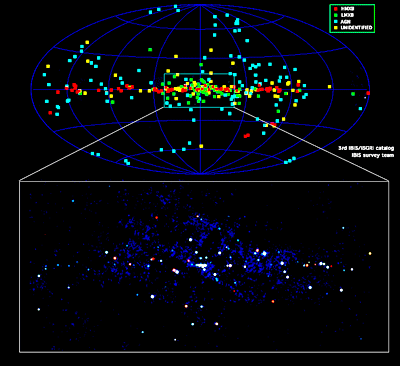
Integral's latest survey of the gamma-ray universe continues to change the way astronomers think of the high-energy cosmos. With over seventy percent of the sky now observed by Integral, astronomers have been able to construct the largest catalogue yet of individual gamma-ray-emitting celestial objects. And there is no end in sight for the discoveries.

Integral is the European Space Agency's latest orbiting gamma-ray observatory. Ever since Integral began scientific operations in 2003, the project team has been devoting a substantial proportion of its observing time to a survey of the gamma-ray universe.